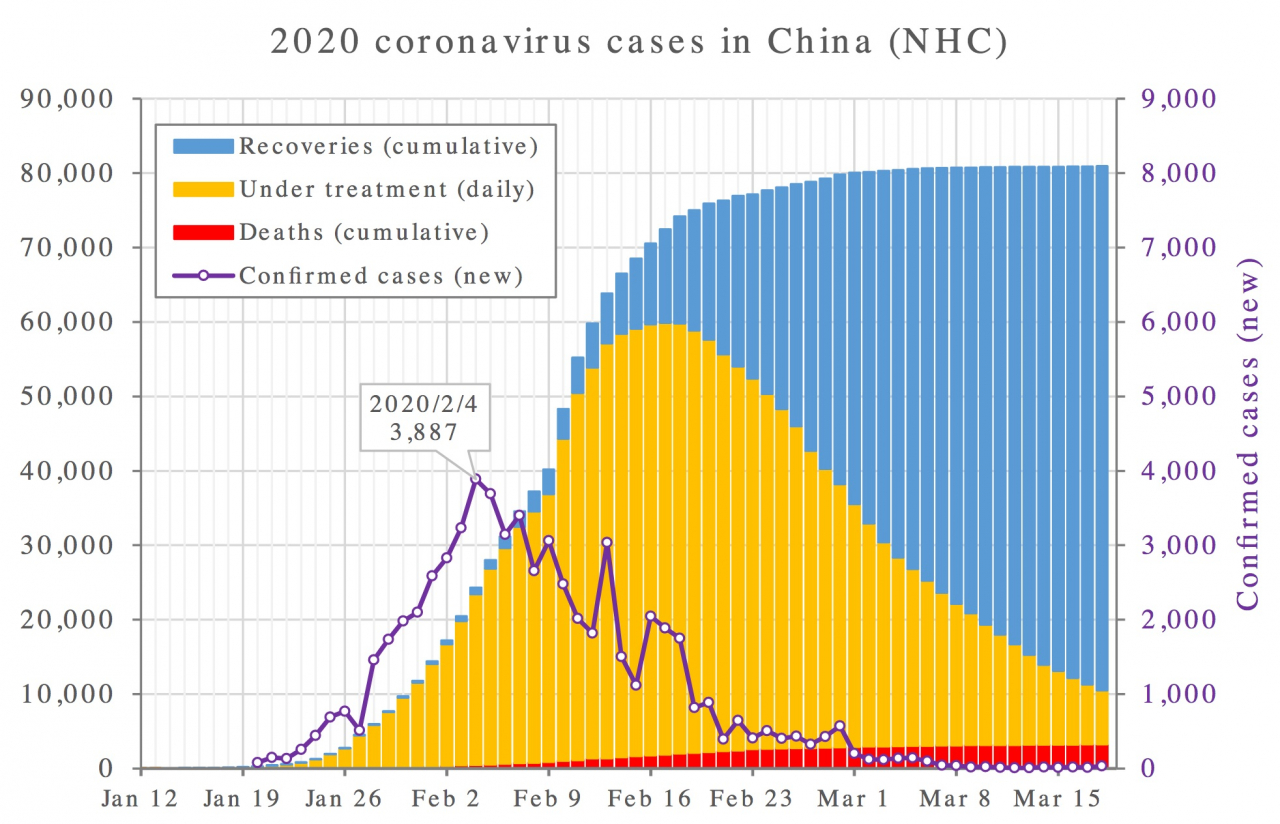
On Thursday 19 March, Italy surpassed China in terms of coronavirus deaths. It was also the first day that no new infections were detected in China. Other East Asian countries such as Japan, Singapore and South Korea have also been better able to manage the coronavirus epidemic than many European countries. Why is this?
The warning from Dr Tedros, head of the World Health Organisation (WHO), was spot on. «Washing your hands and coughing into your elbow reduce the risk, as does “social distancing”,» he said at a press conference on Monday 16 March. «But that will not enable us to overcome the pandemic (an epidemic that spreads over a very large geographical area, editor's note). Our message is: test, test and test again.»1 This is one of the most important lessons to be learned from the experience of China and other East Asian countries.
We cannot control this pandemic if we do not know who is infected.
Dr Tedros noted that while countries are now taking measures to limit contact between people («social distancing»), most of them are failing to actively detect infected individuals. Yet, according to the WHO, this is the cornerstone of an effective response to the coronavirus epidemic. «The most effective way to prevent infection and save lives is to break the chain of transmission. And to do that, you have to test and isolate.» According to Dr Tedros, «you can't put out a fire with your eyes closed. And we can't control this pandemic if we don't know who is infected.»
The WHO has learned this lesson from China. At the end of February, an international group of scientists travelled there on a mission to learn from the management of the virus epidemic. In their report, the scientists praise the Chinese government's approach. They refer to it as «the most ambitious, aggressive and rapid effort ever made to contain an epidemic».2
In cities where the number of cases is high, residents' body temperatures are being taken on a massive scale.
The mission was led by Dr Aylward, a man with 30 years of experience in fighting polio, Ebola and other large-scale epidemics. In a lengthy interview with New York Times, He explained China's approach to the Covid-19 epidemic, the disease caused by the new coronavirus.3
He explains that the approach differed depending on whether cities had no cases, few cases, or many cases. In each case, they started with basic measures: washing hands, wearing masks, not shaking hands, recognising symptoms. In cities with high numbers of cases, residents' body temperatures were taken on a massive scale. Sometimes they even stopped cars on the motorway to check if anyone had a fever. Where there were really large groups of patients, schools and leisure facilities were closed. But only the city of Wuhan and neighbouring cities were completely locked down.
Looking for patients
Healthcare was reorganised in a short space of time: «The first half of medical care was organised online, to avoid people having to go to the doctor,» explains Dr Aylward. «If you need a prescription for insulin or heart medication, you can easily request it and it will be sent to your home. »
Patients with symptoms of Covid-19 are kept away from normal medical facilities and sent to a special fever clinic. There, their temperature is taken, they are examined and questioned, and they immediately undergo a lung scan. The whole process takes a few dozen minutes. If the patient is suspected of being infected with coronavirus, a sample is taken from their nose for testing.
In Wuhan, at the beginning, two weeks passed between the first symptoms and isolation. This period has been reduced to two days. The virus has almost no chance of infecting other people.
Patients who may have Covid-19 are not sent home, but must wait for the test results. This takes no more than four hours. If the test is positive, the patient is immediately isolated. Those with mild symptoms – i.e. anyone who does not need oxygen – do not go to hospital, but to a specially equipped centre. These centres are usually set up in sports complexes and have up to 1,000 beds. Patients with severe symptoms or those at risk go directly to hospital and into isolation.
Dr Aylward is impressed by how this system has been perfected: «In Wuhan, at the beginning, two weeks would pass between the first symptoms and isolation. This delay has been reduced to two days. This means that there are obviously far fewer infections. The virus has almost no opportunity to infect other people.»
Another important factor is that all of this is free for the public. The government pays for all coronavirus tests. Those receiving treatment do not pay anything either, even those without insurance. People infected with coronavirus can count on free medical care. Assistance has also been provided outside the medical sector. For example, free transport has been organised so that everyone can return home after Chinese New Year, food has been provided, and workers have been given extra days off to make up for the period of inactivity.
A national mobilisation
Dr Aylward also highlights the involvement of the whole country: «No one complained or blamed Wuhan for being responsible. On the contrary, there was a huge desire to help Wuhan. Other provinces sent 40,000 healthcare workers, many of whom volunteered. Many civil servants were given new tasks. On the roads, workers took people's temperatures, provided food or traced patients» contacts. In one hospital, I saw a woman who explained to me how to put on sterile clothing. I asked her if she was the infectious disease expert. She wasn't. She was a receptionist, but she had been trained."
«I spoke to many people outside the official circuit. They were all committed, as if it were a war. They saw themselves as being on the front line, protecting the rest of China from the virus, and therefore also the rest of the world.»
Technology also plays a major role. «They are really trying to trace every contact of the 70,000 cases, so they are processing massive amounts of data,» explains Dr Aylward. «For example, we went to Sichuan, a huge rural province, where they had installed 5G. We were in the provincial capital, in a control room with giant screens. The experts were racking their brains over the spread of the virus in a particular group. The district headquarters was also monitoring the situation on another screen but couldn't figure it out either. So they called the team on the ground. Imagine, suddenly we saw a team leader, in the middle of a field, on his mobile phone, videoconferencing with the provincial governor, about 500 kilometres away.»
Some media outlets sometimes claim that this can be explained solely by the fact that China is a dictatorship, but Dr. Aylward has a different opinion on this. «I spoke to many people outside the official circuit, on trains, in hotels, on the street... They were all committed, as if it were a war. They saw themselves as being on the front line, protecting the rest of China from the virus, and therefore also the rest of the world.»
Similar approaches in Asia
Other countries in the region adopted a similar strategy. Singapore also immediately focused on rapid detection and isolation of patients. Their contacts were also meticulously tracked. People with whom patients had been in contact were actively traced, tested and quarantined if necessary, or monitored in other ways.4 This approach has proven to be three times more effective in detecting patients with coronavirus than methods used in other countries.5 Japan also opted for a highly targeted approach. Initially, most of the country's patients came from China. Once a local group of infected people was discovered in Wakayama Prefecture, their potential contacts were also identified and investigated.6
South Korea was still somewhat hesitant, and only began testing when the epidemic was already relatively advanced. But when the Koreans started testing, they did so on a massive scale. Every day, 15,000 to 20,000 people are tested for the virus. As soon as a patient tests positive, their entire network is mapped out so that any spread of the virus can be identified. The country is going to great lengths in this regard, even using GPS data from mobile phones.7
Criticism of the Chinese approach
Serious mistakes were made at various levels of the Chinese state apparatus at the beginning of the epidemic. The Chinese authorities admit this. But it was quickly corrected.
Nevertheless, criticism can also be levelled at China's approach to the Covid-19 epidemic, particularly during the initial phase. One example is the case of Li Wenliang, an ophthalmologist from the city of Wuhan. On 30 December, he sent a warning to his friends. In his message, he mentioned SARS, the previous version of the new coronavirus, which struck China fifteen years ago. For this, he was punished by the local authorities, who believed he was spreading panic.
There is no doubt that serious mistakes were made at various levels of the Chinese state apparatus at the beginning of the epidemic. The Chinese authorities admit this. President Xi Jinping criticised the way decisions were initially made at the local level. But he added that this attitude quickly changed, and that a sense of responsibility and a willingness to act collectively quickly emerged. Several officials were dismissed from their posts because they had made serious mistakes.8
But this was quickly corrected. The city's health services then promptly reported the outbreak of this virus to the WHO. The exact type of coronavirus was not identified until 7 January, and a few days later, the Chinese health authorities shared the complete genome of the virus so that laboratories around the world could have this information and get to work.
A single axis
Despite this criticism, the Chinese approach is above all very instructive. It was divided into two parts: on the one hand, it required great sacrifices on the part of the population, who had to significantly limit their mobility and social life. On the other hand, the state mobilised an entire system to detect and isolate Covid-19 patients and trace their contacts as early as possible. This same approach has also been successful in other countries.
The WHO notes that while Western countries are now demanding a change in behaviour by imposing social distancing, restricting freedom of movement and quarantining entire regions, they are failing to address the second aspect: actively searching for patients with Covid-19. Worse still, in the United States there is even a huge shortage of testing kits, but people are acting as if nothing is wrong.9
In fact, the Western strategy is based on a fragile foundation: it requires a huge change in behaviour on the part of the population, but the public authorities are not taking sufficient measures to detect the virus. This is hardly surprising. To apply the Chinese method, you need a strong public health service, developed at all levels, close to the population, and a state capable of mobilising the entire population.10 This is what has enabled the active and highly effective tracing of patients with Covid-19. The same approach has also been seen in Singapore, Japan and South Korea.
This is less the case in European countries, where austerity and privatisation have undermined the healthcare system. And unbridled capitalism has further damaged the American healthcare system. This is no secret. Nearly 30 million Americans cannot even dream of having health insurance. Even if Covid-19 tests were offered free of charge to patients, they would not be able to pay for treatment.
But here too, our public health system is being dismantled little by little, and the profit motive still too often prevails. The experience of China and other Asian countries shows that a public health system is the best tool for mobilising the people and resources needed at critical times, such as during the Covid-19 pandemic.
1 https://www.who.int/dg/speeches/detail/who-director-general-s-opening-remarks-at-the-media-briefing-on-covid-19—16-march-2020
2 https://www.who.int/docs/default-source/coronaviruse/who-china-joint-mission-on-covid-19-final-report.pdf
3 https://www.nytimes.com/2020/03/04/health/coronavirus-china-aylward.html
4 https://www.cdc.gov/mmwr/volumes/69/wr/mm6911e1.htm
5 https://www.medrxiv.org/content/10.1101/2020.02.13.20022707v2
6 https://www.washingtonpost.com/world/2020/03/13/how-countries-around-world-have-tried-contain-coronavirus/
7 https://www.aljazeera.com/news/2020/03/italy-south-korea-differ-tackling-coronavirus-outbreak-200313062505781.html
8 https://www.globaltimes.cn/content/1182223.shtml
9 https://s3.amazonaws.com/ASPPH_Media_Files/Docs/ASPPH.Statement.Covid-19.Testing.3.13.2020.pdf
10 https://www.vivasalud.be/fr/nous-avons-besoin-de-soins-de-sant-publics-forts-pour-endiguer-la-pandemie-globale-du-corona-virus/