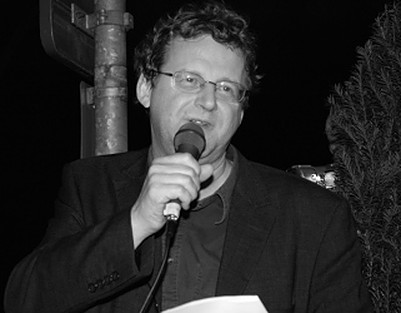
Viva Salud was founded under the name Medicine for the Third World (M3M) in the late 1980s. Dirk Van Duppen was one of the pioneers who founded this organisation upon their return from Lebanon, where they had been working in Palestinian refugee camps. Having just learned of his passing, we would like to highlight his contribution.
The question is: Who owns the fishing boats?
“Viva Salud was founded under the name Medicine for the Third World (M3M) in the late 1980s. Doctors from Medicine for the People travelled to Lebanon to work in Palestinian refugee camps. Upon their return, they founded M3M, along with a few other doctors. The way we work has evolved, but we have remained true to the principles and ideals of the pioneers.” This is how we at Viva Salud described our roots. But what we didn't say was that Dirk Van Duppen was undoubtedly THE pioneer par excellence.
Dirk Van Duppen, a general practitioner with Médecine pour le Peuple, has an incurable disease: he is suffering from pancreatic cancer for which there is no treatment. In his farewell interview in Humo, Dirk recounts how one day a professor asked him: “What is the best way to contribute to development: give people fish or teach them how to fish?“ To which he replied: “In my opinion, it's more a question of who owns the fishing boats.” This response reflects the vision that Dirk and his friends had when they founded M3M in 1988. Their basic premise was: “Health is a matter of fighting injustice.” This was the title of their first brochure, which had to undergo quite a few cuts and adaptations before being transformed into a somewhat faded slideshow: M3M's first training courses could begin.
“Health is a matter of fighting injustice” sums up M3M’s vision and approach. Namely, that our living and working conditions, our place on the social ladder, and inequality and injustice in society are more important to our health than genes and microbes. And that any action for health in the South, any initiative for international solidarity, must start from a global assessment of the situation. “Rather than putting a band-aid on a wooden leg, we must look for the causes and tackle them,” Dirk keeps repeating.
Dirk pored over the annual reports of UNICEF and other international institutions. He wanted to use figures and facts to expose inequality around the world. But he also wanted to highlight the good health outcomes achieved by Cuba, China and the Indian province of Kerala, with their socialist or alternative models of society.
In the early 1990s, the world was rocked by several shock waves. Dirk always had the energy to analyse and evaluate them each time and to organise high-profile actions. So when, during the first Gulf War (1991), the argument of a “duty to intervene humanitarily” was used to justify this war over oil, M3M's response was to join the anti-war movement, set up solidarity missions in Iraq and develop a well-argued counter-analysis. “First analyse the interests of the major powers so that you can then place their humanitarian rhetoric in context... and not the other way around” was the reasoning. This can still be “copied and pasted” as it stands today.
In response to the terrible genocide in Rwanda (1994), in which nearly a million Rwandans were massacred with Western complicity, Dirk and M3M mobilised once again, sending brigades to Rwanda, launching a “Rwandan Child Sponsorship” project and setting up a large-scale “Rwanda Tribunal” in Brussels. And when war broke out in the former Yugoslavia following nationalist escalation, M3M turned its attention to the Balkans, with solidarity missions, anti-war demonstrations, publications and conferences on war and peace in the heart of Europe.
Dirk Van Duppen is the main author of the book ‘Ngo’s, missionarissen van de nieuwe kolonisatie?’ (1994), which explored M3M’s vision in greater depth and stimulated debate. Marx and Engels were called upon to reinforce the framework of the analysis, and with regard to international relations, Dirk drew on Lenin's major writings on imperialism. In this way, he wanted to show how society is constructed and how it can be changed. By choosing sides. By taking action. By helping to build a counter-power. By defending a different, better world, based on solidarity and genuine collaboration.
Thank you, Dirk.