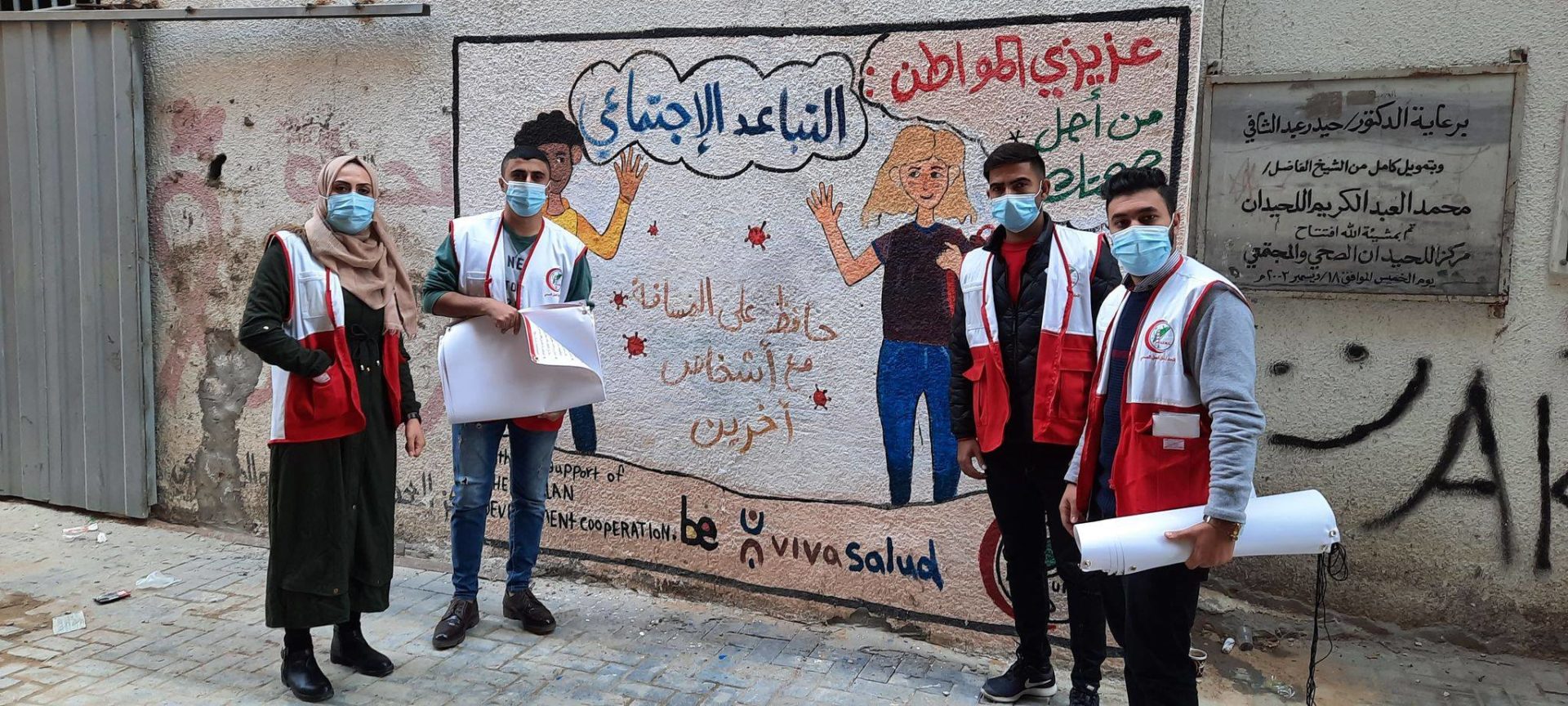
The number of new cases of coronavirus is rising steadily in Europe. Gaza,a an overpopulated enclave that has been under Israeli blockade for 14 years. At the forefront of raising public awareness, UHWC is doing its utmost to slow the inexorable wave.
Every day, volunteers raise awareness in their communities in shops, streets and schools. Doctors also reach out to the most vulnerable to deliver medicines and basic healthcare. This work is crucial to curbing the contagion and continuing to make healthcare accessible.
The right to access to healthcare for all
Suhail Al Tanani is responsible for the advocacy programme at our Palestinian partner Union of Health Work Committees (UHWC) in Gaza. He talks about the impact of the corona pandemic on the daily lives of the people of Gaza and how UHWC is doing all it can to reach everyone.
“In the health sector, the government has had to reduce medical services. On the other hand, the United Nations has had to reduce the medical services previously provided to the Palestinians. Many social activities have had to be cancelled due to social distancing and the measures imposed as a result of the pandemic. The Union of Health Work Committees is trying to replace some of the services cut by UNRWA, and is implementing various strategies to provide some health services and replace those cut by UNRWA and the local government. The Union of Health Work Committees is ensuring the protection of its members working during this pandemic.
We believe that it is our right to have access to health care and to be able to fight against the Israeli occupation, which imposes strict confinement and prevents the arrival of all the medical products needed to protect our workers. The new regulations introduced by the Israeli occupation prevent the Gaza Strip from having access to the fuel needed for the only power station available in Gaza. Access to electricity is therefore limited to just four hours a day.”
Creative children in prevention
Lamees Abu Salama dances in the Debka folk dance group. She tells the story of how, because of the corona pandemic, their group looked for creative alternatives to serve the community.
“We can no longer go to school because of the pandemic, and we cannot take part in Assrya Centre activities. However, we are in contact with the Assrya Centre electronically and our Dabkeh teacher sends us videos of Dabkeh classes while we stay at home for our own safety. The Debkeh group has achieved a video clip to raise awareness during the pandemic. This video has been widely shared on social networks. It explains how to manage social distancing during the pandemic.”
Malak Al Shintawi takes part in activities organised by UHWC for children
“The coronavirus is preventing us from going to the centre where we were taking part in various cultural activities, such as poetry and Debkeh. We were contacted by the Assrya Centre via their Facebook page «Joha Wa Albatreeq». I have a talent for poetry and I make short videos to help others understand the Coronavirus pandemic. I am happy that this centre is providing help during the pandemic.”
A group of women goes online
Hanan Shabat takes part in activities organised by the UHWC women's group.
“Because of the confinement, we can't leave our homes. That's why the Alawda centre is providing us with online services to help the women's community have a safe space and to support them socially and health-wise. As we can no longer visit the centre, we now log on to the centre's page to discuss our social difficulties. We are happy to have access to such services to maintain our contact with the centre during this pandemic.”
Young people help where they can
Rashad Abu Mdalah takes part in UHWC youth activities.
“Here in Gaza, we have been affected by the global pandemic, which has led to the interruption of most of the services provided by the local government. Containment has forced people to stay at home to avoid this virus and its dangers to our health. The pandemic is affecting the health system in Gaza, as well as the economy and social life; it is putting Palestinians in a difficult situation, in addition to the difficulties they face in their daily lives.
At the start of the pandemic, many families were infected with the virus, so we are afraid to leave our homes. I consulted the director of the Alawda Centre, Dr Robhi Naseer, and Dr Ahmad Mahana, to get any useful information that could help during the pandemic. Sometimes, when necessary, I went to the centre to talk to them.
The centre helps us by providing all the information and medical equipment needed for hygiene measures. The centre provides masks and gloves, and allocates patients to the centres so that they do not come into contact with each other. This is also done to prevent the centre from becoming a place where the virus can spread.
We would like to thank the centre for its exceptional service during the pandemic, despite all the other difficulties encountered. And for its compliance with all the measures imposed. The centre has proved its responsibility and its concern to save human lives, despite the social and economic difficulties. We hope that the centre will continue its work to help the Palestinians during this crisis.”