Imagine the world was plagued by a deadly virus and you had an effective vaccine... Would you make it available to everyone, at the lowest possible price? Or would you only sell it to those who could afford it? And let the virus circulate quietly in the rest of the world? You'd probably choose the former. In reality, however, it's the latter that wins out.
On the one hand, there is an abundance of Covid-19 vaccines in one part of the world. And pharmaceutical multinationals raking in super profits. On the other, a large part of the world's population has no protection against the coronavirus.
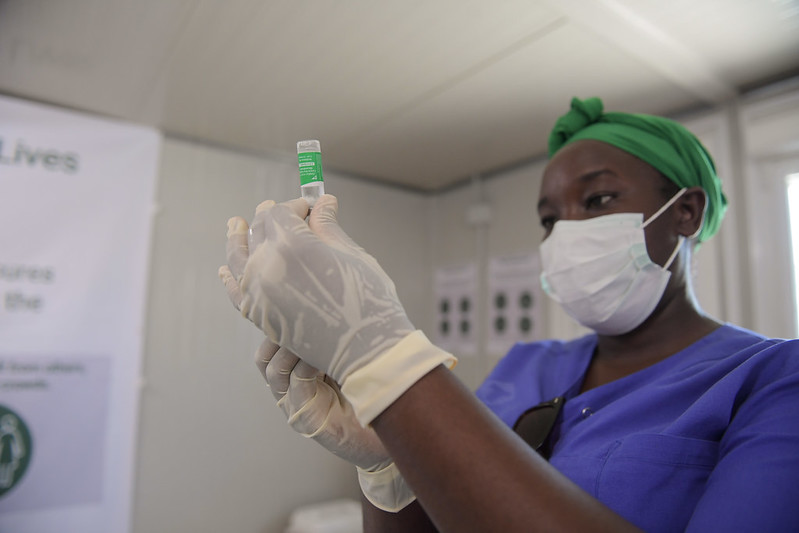
According to Dr Tedros, Director of the World Health Organisation (WHO), 4.8 billion doses of the Covid-19 vaccine have already been administered worldwide, including just 87 million in Africa. That's less than 2 % of the total.
At present, ten countries share three quarters of the vaccines administered, while in poor countries only 2 % of the population is vaccinated, he added. While in rich countries, on average, more than half the population has already been vaccinated, in poor countries this figure will only reach 20 % at the end of this year, if all goes well.
Extreme inequality
Together, the G7 countries (United States, Canada, France, Germany, Italy, United Kingdom and Japan) have ordered 2.4 billion doses in addition to the number of doses required to vaccinate their population. This represents a total of five doses per person, whereas only two doses are sufficient (or even just one, in the case of the Johnson & Johnson vaccine).
At the end of July, 26 million doses remained unused in the United States, enough to vaccinate 13 million people. Some of these vaccines reached their expiry date in August. Canada, Germany, Israel, Poland, Lithuania and Romania have all already destroyed vaccines because they were out of date. At the end of this year, the surplus of doses in rich countries should reach one billion units.
Meanwhile, the multinational pharmaceutical companies are already advocating the administration of a third (booster) dose, supposedly to boost the immune system. «Even if it is not useful for everyone, it is at least useful for the most vulnerable people in society», they insist.
However, according to the WHO, there are in fact no no proof whether a third dose would be useful or necessary. The Director of the WHO, Dr Tedros, made no secret of the fact that his annoyance Last week, we brought together 2,000 experts from around the world to discuss all the data concerning these booster doses. The only thing that is clear is that the first doses should be administered to ensure that the most vulnerable people are protected before administering booster doses.«
«This amounts to handing out lifejackets to people who already have one, while leaving others to drown without one, added his WHO colleague, Dr Mike Ryan..
But this is already happening. The United States, France, Germany and the United Kingdom have already announced their intention to carry out a third injection. Some countries have already started. Israel, Turkey and Chile have already administered 10 million booster doses. This is more than the total number of people fully vaccinated against Covid-19 in Nigeria, Ethiopia, Kenya, DRC, Chad and Cameroon. And this is only the beginning. In the United States, more than 100 million people will be eligible to receive a booster dose by the end of the year.
It's cynical, to say the least. Meanwhile, the virus continues to circulate in the rest of the world. As it does so, it evolves freely, allowing new variants to emerge. These new variants compromise the effectiveness of vaccines. As a result, some people will actually need booster shots and probably a new vaccine at a later date.
The pharmaceutical multinationals, for their part, are drowning in profits. Pfizer, BioNTech, Moderna, AstraZeneca and Johnson & Johnson have all announced that they are preparing to sell billions of doses of vaccine against the coronavirus, with profits in the hundreds of millions of dollars.
An artificial shortage
Surplus on the one hand and shortage on the other. How can such a situation be explained?
It all began more than a year ago, well before the coronavirus vaccines came onto the market. At the time, rich countries were already placing their orders in advance. The pharmaceutical multinationals were thus able to invest without risk, because sales were already assured. Millions of doses were reserved for around thirty countries.
In addition, the big pharmaceutical companies fiercely protect their intellectual property through patent legislation, thereby controlling who can produce their vaccines and in what quantities. These companies have no interest in massively increasing production. On the contrary, the scarcity of the product suits them all the more as it allows them to maintain high prices in a highly lucrative market. This is how, at the beginning of August, Pfizer and Moderna were able to increase the prices of their vaccines by respectively 25 and 13 %, without providing the slightest explanation.
These companies produce mainly for the rich countries, and it is there that they have centralised their production. The already limited production capacity of developing countries is being wiped out for the benefit of the rich West. Dr Tedros of the WHO made no secret of the fact that his astonishment on learning that Europe currently imports Johnson & Johnson vaccines, which are manufactured in South Africa.
«I was astonished to learn that vials of J&J's coronavirus vaccine are leaving South Africa for Europe, where almost all adults have already been vaccinated. We urge J&J to give urgent priority to distributing vaccines in Africa before exporting to rich countries, which already have sufficient access to vaccines.»
The sham of «vaccine donations»
Rich countries boast about giving vaccines and present this as the solution. In reality, it's a sham, nothing more and nothing less. Last year, the WHO set up Covax, a global vaccine distribution management mechanism, with the aim of distributing enough vaccine to vaccinate at least 20 % of the world's population by the end of the year. However, Covax is already significantly behind schedule, while the number of doses promised by the G7 represents only 8 % of the total doses required by Covax.
However, Covax does not offer a real solution because it remains a mechanism dependent on the goodwill of pharmaceutical multinationals. The only sustainable solution is to give developing countries the means to set up their own vaccine production. However, pharmaceutical multinationals are reluctant to extend their production beyond the richest markets.
Production in Western hands
The entire Pfizer/BioNTech and Moderna production chain is currently concentrated in Europe and the United States. However, Pfizer plans to set up production units in South Africa and Brazil, but these will be limited to «fill and finish» operations. In other words, they will only be ampoule filling and packaging plants. BioNTech has signed an agreement with Shanghai Fosun Pharmaceutical for the Chinese market, and plans to open a plant in Singapore. Moderna has signed an agreement with South Korea to set up a plant there.
AstraZeneca and Johnson & Johnson also concentrate their production lines in Europe and North America. However, they have also licence agreements with producers in India, China, Brazil, Mexico, Australia, Japan and South Africa. As the example of the J&J factory in South Africa shows, production from these factories is still sometimes diverted to Europe or the United States.
Chinese vaccine manufacturers Sinopharm, Cansino and Sinovac have concluded licence agreements or set up local production in Africa (Egypt, Morocco, Algeria), Asia (Indonesia, Malaysia, UAE, Pakistan, Bangladesh, Uzbekistan), Europe (Serbia and Turkey) and Latin America (Argentina, Brazil, Chile, Mexico). Russian investment fund RDIF (Russian Direct Investment Fund), producer of the Russian vaccine Sputnik V, is very active in the distribution of its licences in countries around the world. It has already shared its know-how with 27 different producers, including in India, Serbia, Argentina, Brazil, Mexico, Algeria, Egypt, Turkey, Malaysia and Iran.
So non-Western producers are doing better than the big pharmaceutical multinationals. But capacity is far from sufficient. Billions of people need to be vaccinated as quickly as possible. We cannot continue to rely on the goodwill of companies. Patents will have to be lifted and know-how shared on a mandatory basis.
Current inequalities in vaccination are unnecessarily prolonging the pandemic. A recent editorial in the British Medical Journal spoke of a crime against humanity The persistent injustice we are witnessing is the direct result of commercial greed and political self-interest. Only grassroots pressure will enable us to put an end to it.
Sign the European Citizens' Initiative to make vaccines a public good: www.pasdeprofitsurlapandemie.eu
Wim De Ceukelaire, Director of Viva Salud
Article published on 2 September in In solidarity