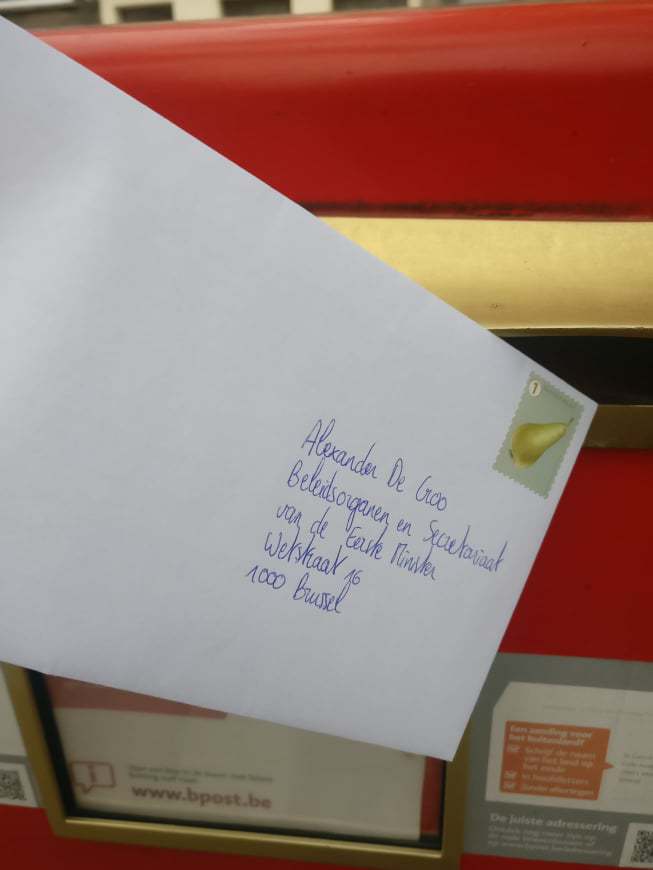
At the end of November, the countries of the world will meet for the Ministerial Council of the World Trade Organisation. They will be deciding on the «TRIPS waiver», the proposal that calls for the abolition of patents on corona vaccines. Our country is still blocking the proposal. In an open letter, former MEPs Marleen Temmerman, Reginald Moreels and Wivina Demeester call on our government to stop opposing the proposal.
Dear Mr De Croo, dear Prime Minister,
In April 2020, in the middle of the first wave of COVID-19, European Commission President Ursula Von Der Leyen made a hopeful statement. The corona vaccine would become our universal common good, available to everyone in the world. «With our global approach, we will make history together», she added in the same speech. In our country, you and other members of the government have rightly repeated that no one is safe in the world until everyone is safe. As concerned Belgian citizens and former ministers and members of parliament, we fully subscribe to this message. But we fear that they will remain empty words as long as our country continues to oppose the TRIPS waiver. That's why, in the run-up to the World Trade Organisation (WTO) Ministerial Council from 30 November to 3 December, we are asking you to take a clear stand in favour of the TRIPS waiver so that we can put an end to the pandemic more quickly.
Worrying inequalities
Despite the great promises made by world leaders at the start of the pandemic, what absolutely had to be avoided happened. The world's richest countries entered into bilateral agreements with the pharmaceutical industry and appropriated most of the available vaccines. The consequences are quite alarming. In the last three months, high-income countries have administered more third doses of vaccine than the total number of injections that low-income countries were able to administer over the whole of last year. On the African continent, vaccination coverage is still below 5% in several countries. This means that, in these countries, vulnerable elderly people and those working in the health sector are not protected, whereas in our country we are planning to invite people to a third injection. The risk of new, dangerous variants of the coronavirus is increasing every day.
For the time being, there are no scientific arguments in favour of extending the vaccine to a third dose. The World Health Organisation (WHO) issued a negative opinion in August and continues to insist on the importance of a first and second dose of vaccine. To contain the virus, it makes much more sense to vaccinate vulnerable groups and healthcare workers in low- and middle-income countries first. Administering additional vaccines on top of the current two doses means that international inequalities will be even more pronounced, and the already limited supply of vaccines will be further reduced. The major challenge today is therefore above all to remedy this global shortage of vaccines. Along with the signatories of this letter, we are concerned that current policy is not sufficiently committed to structural solutions that will make it possible to eliminate the global shortage of vaccines.
The current policy is not a solution
First of all, charity remains at the heart of Belgian policy. It's good that our country is donating 7.3 million vaccines to low-income countries via the COVAX system, But the importance of charity should not be overestimated. Globally, the vast majority of pledges have not yet been honoured. Only 15 % of the more than one billion vaccines pledged by high-income countries have arrived in Africa. In addition, due to unreliable delivery times by the industry and a lack of funding and donations, COVAX has had to adjust its target for 2021 from 2 billion to 1.4 billion doses delivered. Until the beginning of November, only 450 million vaccines in total had been distributed. Charity can speed up the vaccination campaign in the short term in a limited number of places, but it will not solve the pandemic.
Secondly, we have already heard the government say on several occasions that the «TRIPS waiver» is not a solution to the coronavirus crisis. Voluntary cooperation with the pharmaceutical industry and compulsory licensing would suffice. The temporary lifting of patents on vaccines and other means of combating the coronavirus is not a miracle solution. We also need to transfer knowledge and technologies and provide logistical support where health systems are unable to organise a large-scale vaccination campaign. However, according to health and legal experts, this is an essential first step towards increasing global vaccine production capacity. So far, voluntary initiatives have got us nowhere. In May 2020, the World Health Organisation launched the C-TAP, a platform for the voluntary sharing of knowledge and technology. A year and a half later, the platform is still empty. Compulsory licences, meanwhile, have to be applied for country by country and product by product. Yet the current generation of coronavirus vaccines is made up of dozens of different patents, for each stage in the production process. Applying for compulsory licences therefore takes too long. It's a taxing legal procedure that we can't afford to wait for.
Finally, we recognise the government's efforts to further develop local production capacity in Senegal and South Africa. Indeed, African countries need to be able to produce vaccines and medicines themselves in order to be better prepared for future health crises. However, this does not change the fundamental problem we face today: intellectual property rights continue to be an obstacle to universal access to vaccines and other essential tools in the event of a pandemic. Companies in Canada, Bangladesh, South Africa and Denmark, among others, are eager to get on with producing corona vaccines. They are currently blocked because patent-holding companies protect their knowledge and technologies with intellectual property rights. Yet this knowledge and technology was developed with billions of euros of taxpayers' money. According to the UN and WHO, 60 % of the world's population could be vaccinated this year if all the world's production capacity were used. So let's start by ensuring that existing production facilities are brought on stream quickly.
Genuine solidarity is needed
If we want to prevent the collapse of healthcare systems in South America, Africa and Asia, if we want to prevent the global economy from heading towards a 9.2 trillion dollar economic disaster, and if we want to avoid another wave of infection at home, we must change policy quickly. We have already lost too much time. Since India and South Africa proposed the «TRIPS waiver» to the WTO in October 2020, an average of ten thousand people have died every day from COVID-19. The opponents of the proposal, Switzerland, Norway, the United Kingdom and the European Union, therefore bear a huge responsibility. The WTO General Assembly at the end of November is the ideal opportunity for our country to join the call from the majority of the world's countries, scientists, the Pope, trade unions, NGOs, the WHO and the 32,000 Belgians who have already signed up. the European Citizens' Initiative No Profit on the Pandemic. This is how we will finally be able to organise genuine global solidarity, «a crucial condition for defeating the pandemic», in your own words, at the United Nations General Assembly in September.
Yours sincerely,
Wivina Demeester, former Budget Minister and Flemish Health Minister
Reginald Moreels, former Secretary of State and Minister for Development Cooperation
Marleen Temmerman, Director of the Women's Health Department at the Aga Khan University and former Chair of the Senate Group