Every year, the WHO examines the impact of the Israeli occupation on the health of the Palestinian population. During the discussion, the countries of the Global South showed their solidarity with Palestine.
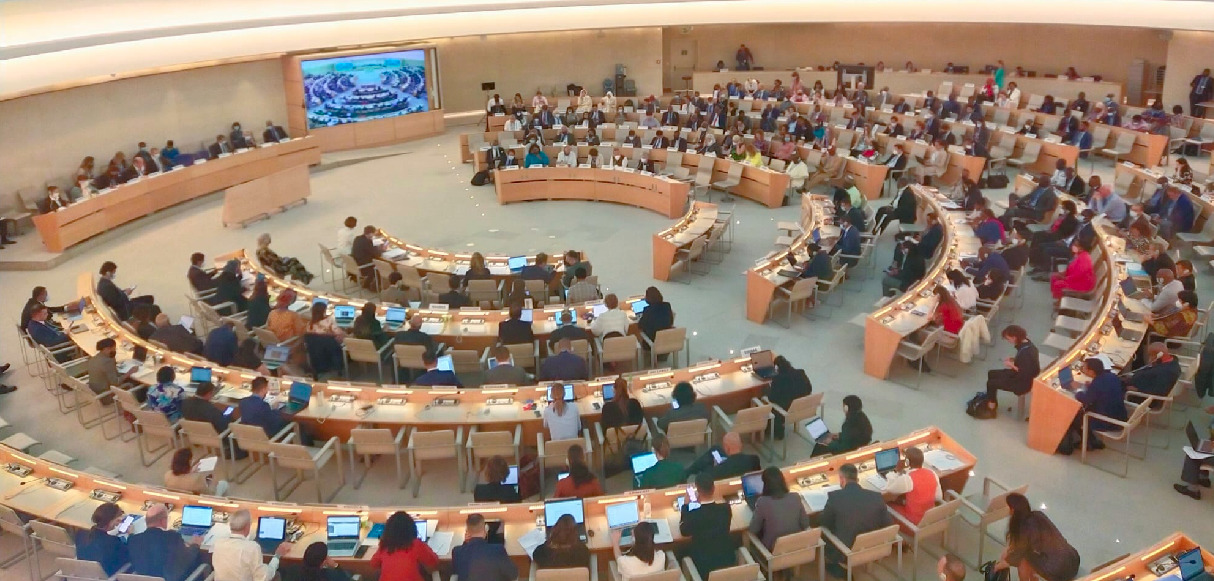
Delegates at the 75th World Health Assembly (WHA) discussed population health in the Occupied Palestinian Territory on 25 May. The countries present voted on a report prepared by Dr Tedros, Director-General of the World Health Organisation (WHO). The report describes the disastrous consequences of the Israeli occupation on the health of Palestinians.
After a lengthy discussion and a public vote, the decision to produce another report next year was adopted. The Director General's report is a regular item on the WHA agenda. But because of opposition from Israel and the United States, the subject causes friction every year. They consider that the subject is too political to be discussed within the WHA.
Fortunately, the countries of the Global South have shown massive solidarity with the Palestinians. Cuba, Venezuela and Bolivia, for example, confirmed their full support for the legitimate resistance of the Palestinian people. The Bolivian delegate condemned the widespread imprisonment of Palestinian children by the Israeli occupation forces and declared that the Israeli occupation «shows no respect for the lives of the Palestinian people». It violates human rights on a massive scale».
Violence against Palestinian health professionals
Many delegates in the room warned that the Israeli occupation army is targeting Palestinian healthcare workers. It does this through violent attacks, constant controls and illegal imprisonment. The Maldives, Tunisia, Niger and Iran called for an end to the army's deliberate attacks on health workers and health establishments.
Dr Tedros' report indicates that the Israeli army and the occupation authorities carried out 235 attacks against Palestinian health workers and institutions. 106 people were injured and 57 ambulances and 124 health facilities were damaged. In 2021, the Israeli occupation army arrested 15 Palestinian health workers. These included Shatha Odeh, a nurse and director of the Health Work Committees. She was sentenced to 16 months in prison in May 2022.
The health consequences of apartheid
The Israeli occupation is disastrous for the physical and mental health of Palestinians. Algeria condemned the recent attacks on the Al Aqsa mosque and the murder of journalist Shireen Abu Aqleh by the Israeli army. For its delegate, the Israeli occupation is a direct attack on the right to health. «The world must stop turning a blind eye», he added.
Dr Tedros' report draws attention to the vast differences in life expectancy between Palestinians and Israelis. In Palestine, the under-five mortality rate in 2019/2020 was 14 per 1,000 children. In Israel, it is barely 4 per 1,000 children. The Israeli occupation also reduces Palestinians' ability to cope with infectious and non-infectious diseases. The Israeli occupation makes access to hospitals and the main health centres more difficult.
A delegate from Jordan said that COVID-19 was making the situation even more difficult. Israel is hindering the supply of vaccines to Palestine. As a result, Palestinian vaccination coverage remains too low. The Lebanese delegation said it was «painful to see that Palestinians are having difficulty getting vaccinated. Whether it's vaccines for babies, children or other groups. The only way to guarantee the right to health in Palestine is to end the occupation».
Despite Dr Tedros' report and the widespread support for the Palestinian cause, the rich countries once again voted overwhelmingly against the proposal. The United States, Israel, Canada and Australia, as well as some European Union countries. However, the negative votes were not enough to stop the decision. This means that the 76th World Health Assembly, in May 2023, will examine a new report on the health situation in occupied Palestine. Another opportunity for more WHO Member States to take the side of the Palestinian people rather than the Israeli occupation.
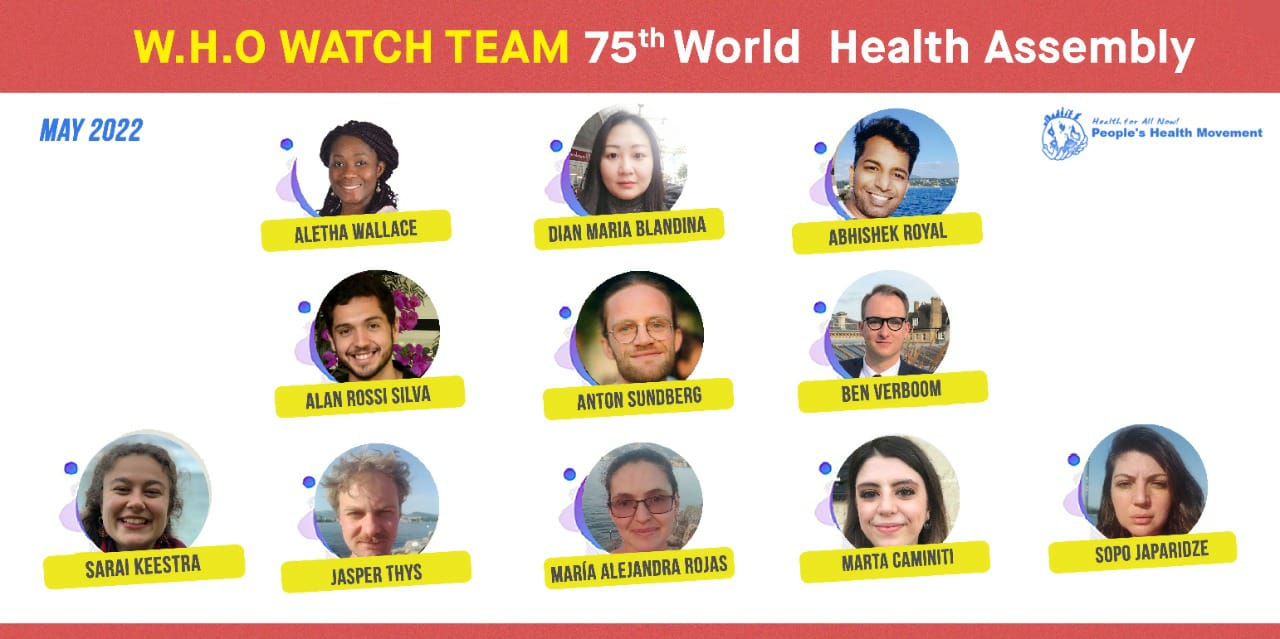
The members of the WHO Watch team are Abhishek Royal (India), Alan Rossi Silva (Brazil), Aletha Wallace (Belgium), Anton Sundberg (Germany), Ben Verboom (Canada), Dian Maria Blandina (Indonesia), Jasper Thys (Belgium), Maria Alejandra Rojas (Colombia), Marta Caminiti (Italy), Sarai Keestra (Netherlands), Sopo Japaridze (Georgia), Lauren Paremoer (South Africa), Jyotsna Singh (India), and Gargeya Telakapalli (India).