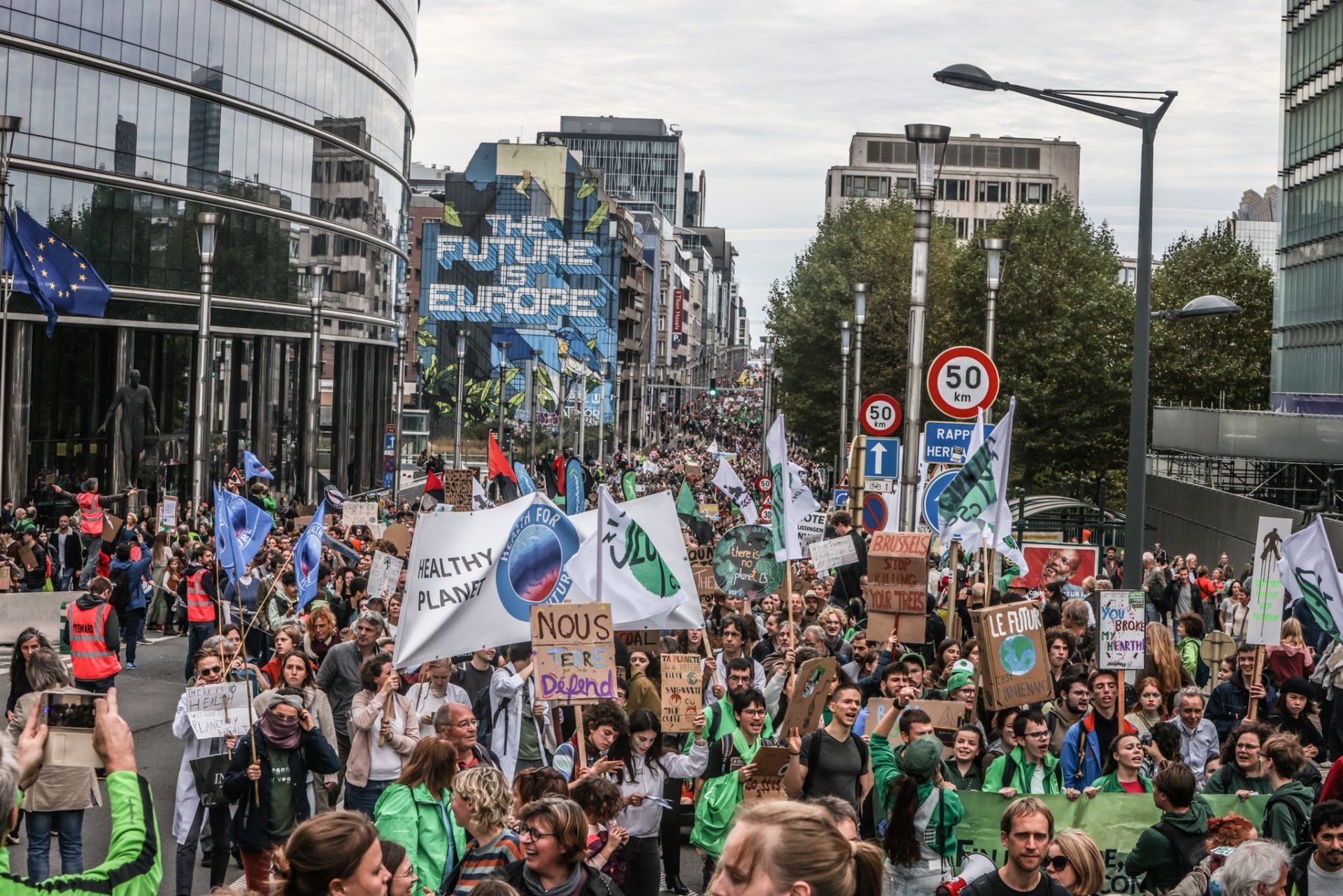
On Sunday, 23 October 2022, we took to the streets of Brussels with thousands of citizens.not·s for the Climate March. This year, we will once again make our voices heard on Sunday, 3 December Our message: « We must act now. Because without climate justice, our health is at risk.« .
The imperative for change
Because, fundamentally, What could be more important than being in good health and having that guarantee for yourself and your loved ones? With record temperatures, droughts and other climate disasters becoming increasingly common, the short-term consequences for human lives are already dramatic. In the long term, this foreshadows an even more chaotic disaster. However, the measures taken are far from adequate to address these challenges.
Climate and health are closely linked. Our environment determines no less than 80% of our state of health.. 5 % relates to our genetic heritage, 15 % to the healthcare system we benefit from (WHO). Therefore, changes in air quality, food, water, as well as repeated heat stress and other climate disasters are all determining factors that directly compromise our good health and healthcare systems. The risks of disease, malnutrition, zoonoses and pandemics are increasing. All this at a staggering financial cost. and relates to global warming. Above all, the majority of economists agree to say that the solutions to be implemented to reduce our greenhouse gas emissions would cost less than inaction.
For good reason, near 99 % people breathe unhealthy levels of air pollution, largely resulting from the combustion of fossil fuels, which contributes to climate change. Every year, 7 million people die from the effects of air pollution. In 2018, air pollution from fossil fuels caused $2.9 trillion health and economic costs, or approximately $8 billion per day.
These figures relate to air pollution, but they are just as unsettling when they concern the management of our water resources or even our agriculture.
Well-being, climate and health come second to profit
Our production systems have long been illogical and unsustainable. The resulting climate disruptions are already here, yet financial interests continue to take precedence over climate and wellbeing issues.
Over the past few decades, more than three hundred infectious diseases have emerged. Their origins are manifold: mass farming, globalisation of human and animal trade, modifications to living species, widespread use of pesticides, endocrine disruptors and other engineering solutions that compete in inventiveness to counter, each time, an irreversible evil.
Capitalism does not save lives. These advances, however comfortable they may make our daily lives, remain as vicious as they are destructive. Also, big industries and their lobbyists are blocking any change, claiming thousands of lives. Just like the agrochemical giants that contaminate our water, soil and food, causing cancer and other diseases. cognitive and respiratory diseases. In the name of profit, the current economic system is destroying the common goods that are health and nature.
Think locally, act globally
It is becoming vital to direct all our resources through the lens of environmental issues, starting now, in order to best counteract the alarming trends that the IPCC has been warning about in vain for 32 years. It is essential to change the paradigm, which relies on free competition and market deregulation at the expense of human and environmental rights. Because, as a reminder, the right to health and healthy working conditions are fundamental rights.
«Instead of think globally and act locally, it would be desirable to reverse the saying. To understand the complexity of the global health challenge and formulate effective responses, we must understand what is happening on the ground and involve civil society ».
Daniel Tarantola, former senior policy adviser to the Director-General of the WHO
Investments must be redirected towards production models that are sustainable for the planet and the environment. By relying on local initiatives for transitioning to a different economic model that is socially responsible and respectful of people and the environment. By investing in sustainable, high-quality public services.
Fortunately, many concerned citizens and organisations are taking action.. The Sunday, 3 December, Thousands of people will march through the streets of Brussels during the Climate March. The climate movement, trade unions, the peace movement, health organisations, youth movements and NGOs are calling for climate justice. Because the fight for climate justice is also a fight for peace, workers' rights and our health.
Here, the event Facebook https://www.facebook.com/events/347668764262261. See you soon!