
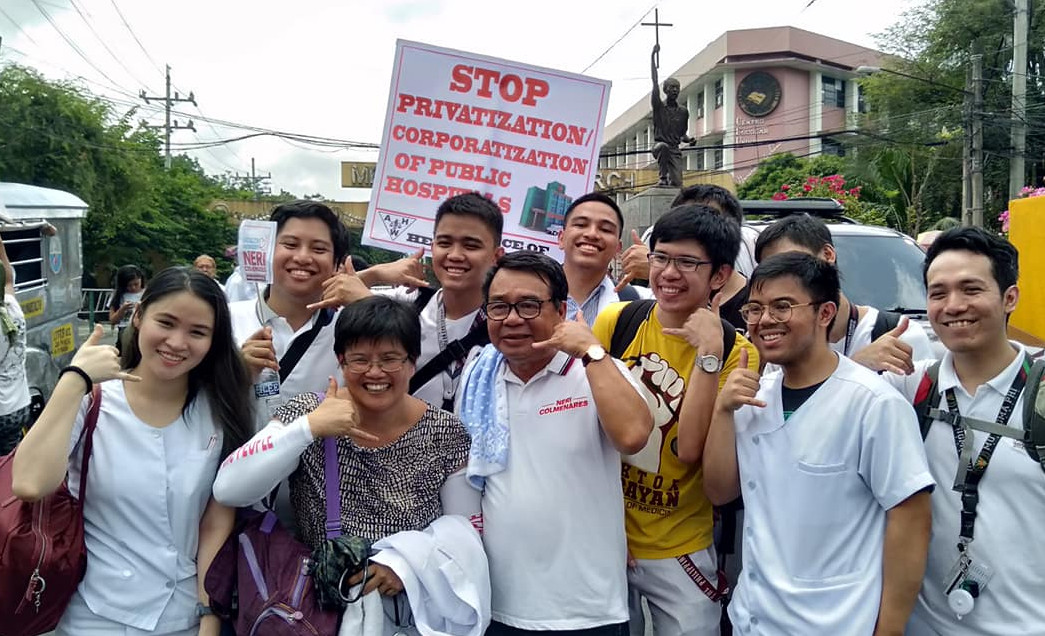
Privatisation of healthcare
In the Philippines, as in many other countries, access to healthcare is not equal depending on whether you are rich or poor. This is due in particular to a major trend towards privatisation in recent years. Instead of investing in public health infrastructures that are accessible to all, the government is gradually allowing them to fall into the hands of private companies. For these private healthcare companies, making a profit is more important than guaranteeing quality care for all. Prices are rising, health is becoming a commodity and the poor are increasingly excluded from the healthcare system.
Multinationals pollute the environment
One of the biggest problems in the Philippines is the exploitation of its resources by foreign multinationals. A number of large companies, particularly in the mining sector, are taking advantage of the country's rich natural resources and causing a great deal of social and ecological damage, which unfortunately often goes unpunished. This primarily affects poor farmers, but also the indigenous and rural populations in the exploited areas. The Philippine government puts the interests of foreign multinationals above the health of the population and allows these terrible exploitations. The deforestation and pollution of the water and soil force them to move inland or to the cities, where they no longer have an income. The consequences of these exploitations are dramatic in social, environmental and democratic terms.
Health and environmental activists under pressure
In the face of all this, there is a strong, progressive grassroots movement in the Philippines that is demanding and fighting for its rights. Whether it's for accessible public health care, or against large-scale mining projects, the struggles are numerous and the people are very active in making their voices heard. But activists, social movements and human rights organisations are under pressure: arbitrary arrests, disappearances, accusations of links with terrorism without evidence (a practice known as «red-tagging»), prosecutions and harassment based on fabricated evidence. Many international human rights organisations have sounded the alarm: the government is using anti-terrorism and anti-money laundering laws to target human rights defenders, humanitarian workers and civil society organisations.
Our partners in the Philippines
Our partners in the Philippines
In a country where the average hospital bill is around three months' minimum wage, the Council for Health and Development (CHD) fights for the right to health for all and offers alternative, popular healthcare to meet people's needs.
The CHD organises a free, comprehensive, community-managed healthcare system. CHD also travels to remote villages across the country to train over 10,000+ community health workers in basic healthcare and prevention.
This vision is in line with a profound desire to overhaul the Philippine healthcare system, which currently favours profit over people.
In recent years, CHD has also been at the forefront of a series of actions opposing cuts to the national health budget.
Based in Manila, the capital of the Philippines, Gabriela is a worldwide movement of Filipino women from marginalised sectors of society. They work to educate women and defend their rights.
The movement offers advisory services, medical missions, free care and training on women's health and rights.
Over time, Gabriela has become more international and now has almost 20,000 members around the world in 16 regional branches.
Gabriela is now diversifying her struggles and leading a number of campaigns. These include «Free our sisters», which aims to free political prisoners illegitimately detained by the Philippine government.
In recent years, Gabriela has also been at the forefront of the campaign to ratify ILO Convention 190. This convention recognises everyone's right to work free from violence and harassment.
Created in response to the dictatorship of President Marcos, Karapatan is one of the largest human rights organisations in the Philippines.
The organisation is regularly at the forefront of human rights demonstrations across the country. Since its creation, it has been meticulously recording cases of human rights violations.
It runs large-scale campaigns to denounce the misuse of security and anti-terrorism laws against activists (“red-tagging”) and the shrinking of democratic space in the country. Karapatan is regularly the victim of judicial harassment and numerous other pressures from the government.
By fighting to defend activists, Karapatan plays a key role in the fight for human rights in the Philippines.
IBON Foundation is a research centre that studies the social, economic and political problems facing the Filipino people.
Through its work, IBON makes complex issues accessible and understandable, particularly for marginalised and vulnerable groups in the Philippines.
IBON provides information and education services to grassroots organisations and produces and distributes textbooks and magazines.
Their teams provide its partners, including Viva Salud, with socio-economic research and analysis on access to healthcare.
These include «Price of privatized healthcare» and «Fail (Phil) Health», which show that neoliberal reforms in the Philippines are destroying the public health system and disproportionately affecting the most vulnerable sections of the population.