Cuba, an island nation in the Caribbean, is more affected than most by the consequences of global warming. The Cuban government understands this and has implemented a strong environmental policy through an ambitious 100-year action plan. The Centro Felix Varela, a partner of Viva Salud and Cubanismo.be, is actively involved in the programme.
An ambitious climate plan
The Cuban government has launched a programme to combat climate change, known as «Tarea Vida» – which can be translated as «Plan for Life». This plan is based on research into climate change initiated by the Cuban Academy of Sciences in 1991. The findings and recommendations of this major project on the dangers and vulnerability of Cuba's coastline led to the creation of a plan based on strategic actions, implemented through 11 specific tasks.
The Centro Felix Varela is actively involved in the programme. Its role is to develop ways of increasing Cuban citizens' awareness of environmental risks and their general knowledge of climate change. It also works to increase public participation in the fight against climate change and to promote a culture that encourages water conservation.
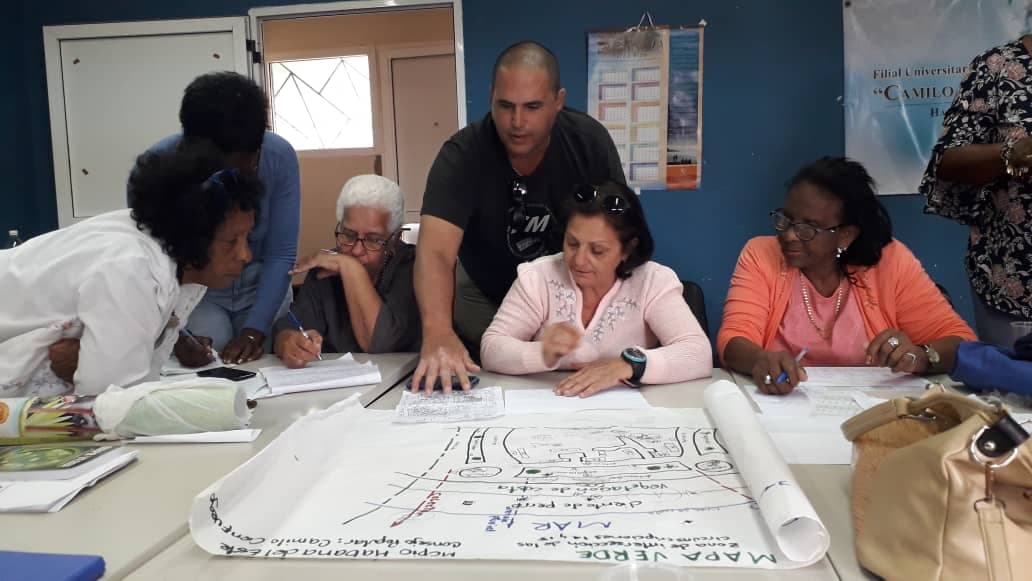
To tackle climate change, environmental education and public awareness are essential. That is why the Centro Felix Varela develops educational initiatives using, in particular, the «Green Mapping» method.
What is Green Mapping?
It is a unique method whereby residents map their local environmental resources themselves. And they do so in the literal sense of the word! Armed with a map and cut-out paper symbols, they set out to explore their immediate environment. Each site with ecological, social or cultural value is assigned a symbol. In this way, people learn more about their living environment, identify problems and seek solutions with local authorities.
In concrete terms: a well with polluted water, a playground in need of renovation, the discovery of a forgotten yet richly valuable plot of woodland, a community centre with adjacent land that could be used as a football pitch... Their slogan: ‘If you map with love, your neighbourhood will be better.‘, which in English can be translated as: ‘If you map your neighbourhood with heart, it will only be better for it.’. Green Mapping in Cuba is organised as a national network and coordinated by the Centro Felix Varela.
Concrete actions and results
Training on issues related to climate change and its impact on life is a goal shared by the entire network. This training has led to the creation of ecological risk maps, which have helped raise awareness and inform communities and local authorities about the vulnerability of their territories.
One of the main risks is drought. 71% of Cuban territory suffers from drought, and 33% of this suffers from moderate to extreme drought. The drinking water reservoirs in the capital, Havana, are currently only 19% full.
The Centro Felix Varela has promoted the dissemination of information to a wider audience through audiovisual media, exhibitions and conferences. In addition, assessments have been carried out on the water infrastructure of various communities. These assessments have led to concrete rehabilitation actions. For example, in the municipality of Venezuela, which has been severely affected by drought, reservoirs have been installed and water filters distributed to ensure access to water for the most vulnerable populations. The local authority has also approved the installation of a water treatment plant.
Thanks to diagnostics, knowledge sharing and maps, concrete actions have been taken:
- training environmental advocates;
- promoting recycling and the rational use of water;
- the promotion of agroecology;
- the organisation of workshops on food preservation;
- the non-use of pesticides;
- planting crops that are resistant to adverse environmental conditions;
- cleaning beaches, rivers and coastlines and reforestation, particularly of mangroves;
- the production of a brochure on cyclones for Cuban students.
Easter campaign for Cuba
With our annual Easter campaign, we are supporting our Cuban partner Centro Felix Varela in the fight against climate change.