The arrival of COVID-19 in Gaza could be catastrophic and would lead to an unprecedented health and humanitarian disaster. It is high time to sound the alarm!
The whole world will soon be in lockdown, but if there is one place in the world that needs more contact with the outside world, it is Gaza, because it has been cut off for far too long.
With over 5,000 inhabitants per square kilometre, Gaza is one of the most densely populated areas in the world and thus a virological hellhole.
The humanitarian situation in Gaza makes it impossible to tackle Covid-19, especially when we see that more developed countries are still unable to contain the virus. Gaza's healthcare system has been failing for years and citizens depend on Israel for critical medical cases. With Gaza's aquifer 97% polluted, they have no access to drinking water. It is impossible to stay at home because half the population barely manages to survive on odd jobs that enable them to feed the other half. Eight out of ten Gazans already depend on humanitarian aid. With more than 5,000 inhabitants per square kilometre, Gaza is one of the most densely populated areas in the world and thus a virological hell.
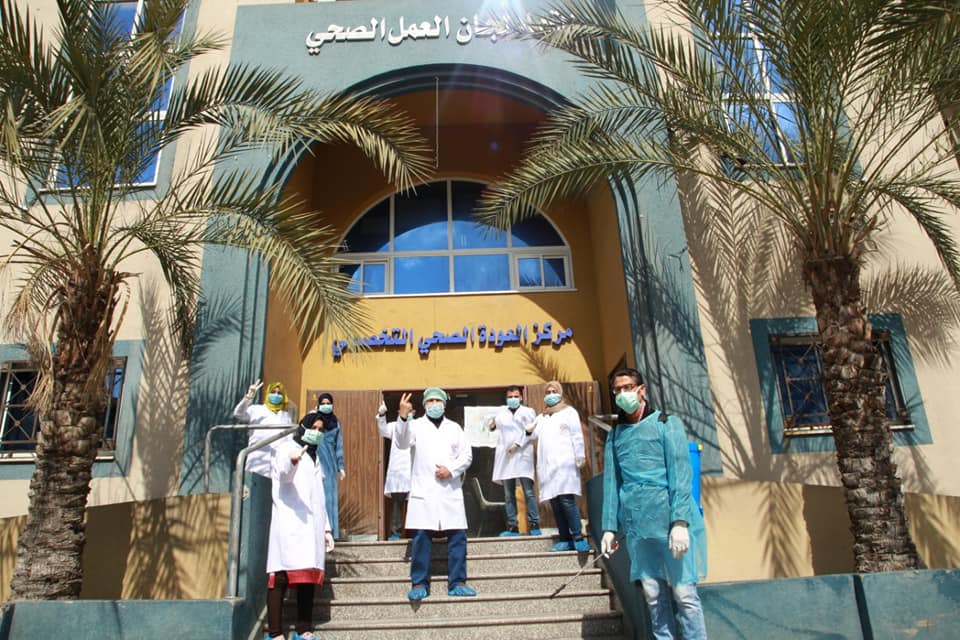
Gaza has two official cases, Palestinians returning from Pakistan who were placed in quarantine upon arrival. Here too, every effort is being made to prevent contagion. Every time we hear about new Covid-19 patients in Israel and the West Bank, our concern grows. We are closely monitoring how Israel is handling the pandemic. Citizens in Gaza are trying to strengthen their preparedness, with modest means, to combat the virus. In Gaza, volunteers, social organisations and businesses are on alert, ready to pull together.
«Our resources are so limited and our health system so fragile. We are expecting the worst. But we are preparing as best we can in our health centres and our hospital» – Haneen J. Wishaw, Programme Manager, Union of Health Work Committees
« The healthcare system in the Gaza Strip is very weak and fragile due to the illegal blockade imposed by Israel. Lifting the blockade would prevent the massive spread of COVID-19 in the Gaza Strip. » explains Amjad Shawa, director of the Palestinian NGO Network (PNGO) and partner of CNCD-11.11.11 and Oxfam. Recurring attacks by the Israeli army are leaving Gaza's health facilities overwhelmed with the wounded. Added to this are the many people wounded by gunfire during the Great March of Return rallies that have been taking place every Friday for the past two years. The blockade prevents the necessary supplies from reaching Gaza and, according to the UN, more than 40% of essential medicines are unavailable. For years, healthcare facilities have also faced electricity shortages, forcing them to spend astronomical sums on fuel to run electricity generators. « Our resources are so limited and our healthcare system so fragile. We are expecting the worst. But we are preparing as best we can in our health centres and hospital to respond to both the Covid-19 crisis and to care for the daily patients who need treatment and cannot afford it. » says Haneen J. Wishaw, programme manager at the Union of Health Work Committees, a medical organisation that partners with the Belgian NGO Viva Salud.
For the time being, public gatherings are prohibited in the enclave and isolation rooms are being built at the Rafah checkpoint, the only entry point still open. Thousands of volunteers are organising themselves to disinfect streets and healthcare facilities, while others are going door-to-door to explain to communities the measures they need to take to prevent the spread of the virus. Telecommunications companies have increased internet capacity. « We are experimenting with online theatre and video animation. Our director's house has become a film studio. We are trying to involve children and young people as much as possible.«We are inventive and we work hard, but we are also very worried,« says Jackie Lubeck of Theatre Day Productions, a partner of Broederlijk Delen. »The international community needs to be aware of our difficult situation.".
Thirteen years of blockade and armed aggression have left their mark on the mental health of the population. Locked in, bombarded with an increasingly bleak future, the weight of reality is becoming harder and harder to bear. To cope with this, Gazans have resorted to community support systems and living together. Families have grouped together: grandparents, uncles, parents, children and grandchildren all live together in the same house. In total, there are eight refugee camps stretching from north to south of the enclave. The houses are crammed together and the streets are extremely narrow and even unsanitary.
Although it is not at all the same thing, the consequences of the lockdown we are currently facing allow us to see in a different light the reality experienced on a daily basis by the two million women, children and men who have been living in almost total confinement for 13 years in Gaza.
Today, for the first time in Europe, we are experiencing almost total lockdown. The austerity policies imposed on our healthcare systems for years have reduced their capacity to respond to a crisis of this magnitude. We lack equipment, medical staff and coherent collective responses. The economy is at risk of collapse, and the most vulnerable social classes are the first to suffer. Although it is not at all the same thing, the consequences of the lockdown we are currently facing allow us to see in a new light the reality experienced on a daily basis by the two million women, children and men who have been living under almost total lockdown for 13 years in Gaza.
While enormous efforts are being made in Europe to try to limit the effects of the coronavirus, nothing is being done to change the reality for Palestinians in Gaza, who have been under blockade for 13 years. We are not equal in the face of the coronavirus, especially in a place like Gaza, which the UN predicted would be unliveable by 2020.
More than ever, Belgium should demand the lifting of the illegal blockade imposed by Israel on Gaza. Necessary medical supplies must be allowed in: ventilators, intensive care beds, testing kits and all equipment that reduces the risk of contamination. We also call for the entry of food supplies and foreign medical personnel to help overcome the crisis. A full supply of electricity is also important so that healthcare facilities can operate their services properly. The international community must also ensure that humanitarian aid is stepped up in the territory during the crisis.
This letter, published on The Evening, is signed by: Broederlijk Delen, CNCD-11.11.11, Oxfam in Belgium, Solsoc and Viva Salud, Belgian civil society organisations active in Gaza.