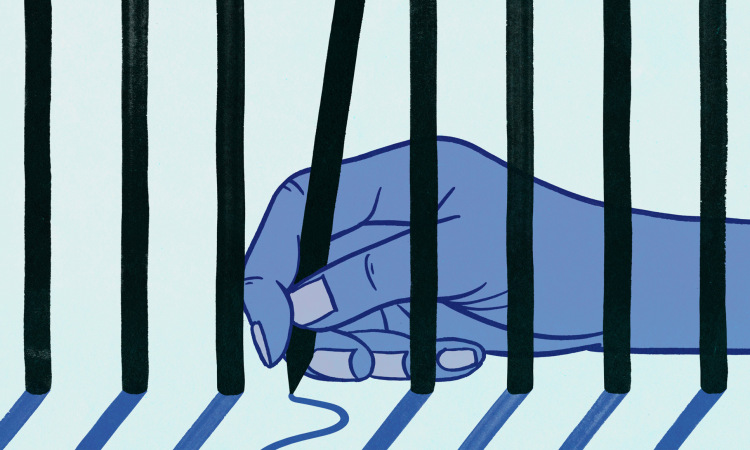
Ubai Aboudi has been a defender of the rights of the Palestinian people for many years. He was arrested in November 2019 and placed in detention in an Israeli prison. Viva Salud and numerous international organisations, including Scientists for Palestine, have launched a campaign calling for his release. Despite the absence of charges, Ubai remains behind bars. He wrote this open letter from his prison cell.
«Despite his arrest, Ubai continues to play an important role in Bisan's work.» – Colleagues at Ubai
I am not going to begin my article with a discourse on the right to health or even the right to appropriate healthcare. Nor am I going to remind you that these are fundamental rights guaranteed by the Universal Declaration of Human Rights. That is an indisputable fact.
A look back: coronavirus is not our first pandemic
The coronavirus (COVID-19) pandemic is no different from other pandemics in human history.
Initially, every epidemic is worrying. It casts a shadow over a given region of the globe and paralyses it with its rapid spread. It then turns into a pandemic and spreads further and further, sowing panic and turning people's daily lives into a nightmare. Often, the virus attacks the most vulnerable people, those whose bodies have already been weakened by a series of chronic diseases. This seems all the more unfair.
In most cases, people will lose their lives due to a lack of adequate care. The human losses will not only be those of millions of poor people in developing countries, but also those living in rich countries who are excluded from the healthcare system or whose healthcare system is unable to respond to such a health emergency.
However, although insidious, a virus is not incurable. It can be contained if the necessary medical care is provided to all infected individuals until a vaccine is found to defeat the virus and keep its spread under control.
But should we not ask ourselves the following question: why, in the 21st century, are our healthcare systems unable to combat the coronavirus?
Healthcare systems unable to respond to the coronavirus crisis
The coronavirus pandemic has exposed the weaknesses of healthcare systems and the limitations of the globalised neoliberal system, or what Samir Amin, the renowned Franco-Egyptian Marxist economist, calls «unbridled neoliberalism».
This system became dominant worldwide after the fall of the USSR in the late 1980s and early 1990s. It is based on completely or almost completely free international trade. Capitalism has transcended traditional national borders and opened up markets on a global scale. The internet, social media and developments in transport have meant that globalised industries depend on relatively long supply chains covering entire countries or even continents, from the supply of raw materials to consumer markets.
In fact, the coronavirus pandemic has highlighted the weakness of investment in the public healthcare sector, even in «wealthy» countries such as France, Italy and the United States. Under the pretext of restructuring, reducing public spending and improving economic efficiency, many countries have begun to privatise their healthcare systems.
In doing so, they have severely undermined access to quality healthcare for their entire population, prioritising budgetary balance and profit at the expense of human life, which is far more precious than any economic calculation.
Thus, US President Donald Trump has sought to undo even the most modest advances towards a comprehensive healthcare system adopted by his predecessor Obama, leaving millions of American citizens without any medical coverage during the coronavirus crisis. Over the past three decades, France and Italy have lost 100,000 and 90,000 hospital beds respectively as a result of cuts in government spending on healthcare following the recommendations of neoliberal economists.
The coronavirus crisis has also revealed the negative effects of international division of labour in the production of medical equipment. Before the crisis, China and Turkey specialised in the production of masks and protective equipment, while India specialised in the production of basic materials used in pharmaceutical manufacturing. When the coronavirus became a global crisis, demand for medical products, ventilators and respirators increased.
Many countries found themselves short of medical supplies in general because the quantities that could be exported and/or imported around the world were limited or simply stopped.
For their part, pharmaceutical companies continued to manipulate drug prices under the pretext that they needed to protect intellectual property and economic returns. A striking example is the appeal by French doctors asking these companies to supply hydroxychloroquine and azithromycin at affordable prices to treat patients with coronavirus. Such an appeal demonstrates the interventionism of these large private companies, which decide market prices even in a global health crisis.
This global shortage of medical equipment and the monopoly of the pharmaceutical sector have exacerbated the health crisis in countries severely affected by the virus and led to an increase in the number of infections and deaths worldwide.
The coronavirus crisis in Palestine
The situation is much worse in developing countries because in many of them, the health sectors are weak, meaning that they are unable to meet the daily needs of their populations. Such countries do not have enough hospital beds or medicines, and they do not have enough medical staff to deal with emergencies such as the coronavirus crisis.
As a Palestinian, I will focus on the policies pursued by the Palestinian Authority in the area of healthcare.
According to a report by the Coalition for Accountability and Integrity – AMAN on spending in the social sectors, published in 2019, the health sector in Palestine has an estimated annual shortfall of ILS 1,400 million, which has a negative impact on its ability to meet the medical needs of the population. In order to meet these needs, a system of medical transfers to Israeli and regional hospitals has been created. This system is based primarily on the purchase of medical services abroad rather than on the consolidation of the Palestinian healthcare system and the nationalisation of services. The Palestinian Authority has spent an average of ILS 700 million per year on this transfer system over the past two decades. The lack of investment in the health sector could have been addressed by redirecting funds from the governance sector, which consumes 43% of the Palestinian Authority's annual budget, particularly through reform of the security sector, which has an annual budget of ILS 5.8 billion. Various analyses show that this budget could be halved by restructuring the security service, merging different security agencies and ending the overlap between the activities of the security services. This would make it possible to meet sectoral needs in relation to the right to health and would provide surplus resources for economic development.
Conclusion: the coronavirus spells the end of the global neoliberal system as we know it.
The current crisis marks the end of the global neoliberal system we have known for the past three decades. A system that has led to a global annual economy of US$85 trillion and global debt of US$250 trillion without solving the problems of poverty, unemployment or climate change.
Worse still, the system has completely failed to respond to the first global health crisis of our time: the coronavirus pandemic.
It is to be hoped that this will spell the end of the notorious «privatised development» model, which severely limits the role of the state and promotes development controlled by the private sector without any central planning or leadership. This system focuses solely on economic development without taking into account the very essence of development: human beings. In this system, the role of the state has become complementary to that of the private sector. The state is no longer called upon to guarantee collective rights such as the right to health, food, education and life. Instead, it is the market that provides the services supposed to guarantee these rights, in accordance with the concepts of profit and loss.
However, the private sector does not aim to improve conditions for humanity, but rather to increase the capital of its owners. This results in a system where billionaires coexist alongside starving populations, where the wealth of the eight richest people in the world is equal to that of the poorest half of the population.
One of the lessons of the coronavirus crisis is therefore this: the system must be changed.
What we need is a system that redistributes the wealth produced by humanity according to people's needs. A system based on the notion that we are part of a larger ecological system.
This reminds me of Barry Commoner's statement: «We can learn a basic lesson from nature here: that nothing can survive on the planet without being a cooperating part of a larger whole.».
Opinion piece written by Ubai Al-Aboudi, Executive Director of our partner organisation, Bisan Centre for Research and Development. This text has been adapted for translation and comprehension purposes. The original text is in English. here.