A future COVID-19 vaccine should be accessible to all. It must not become an exclusive right for powerful states or serve only the profits of the pharmaceutical industry. Together with 13 other organisations, we are launching an appeal to this effect at the annual meeting of the World Health Organisation (WHO).
On 18 May, a World Health Assembly will be held – World Health Assembly (WHA) – very special. Indeed, for the first time in the history of the World Health Organisation (WHO), the General Assembly will take place online.
The reason? The COVID-19 pandemic, of course.
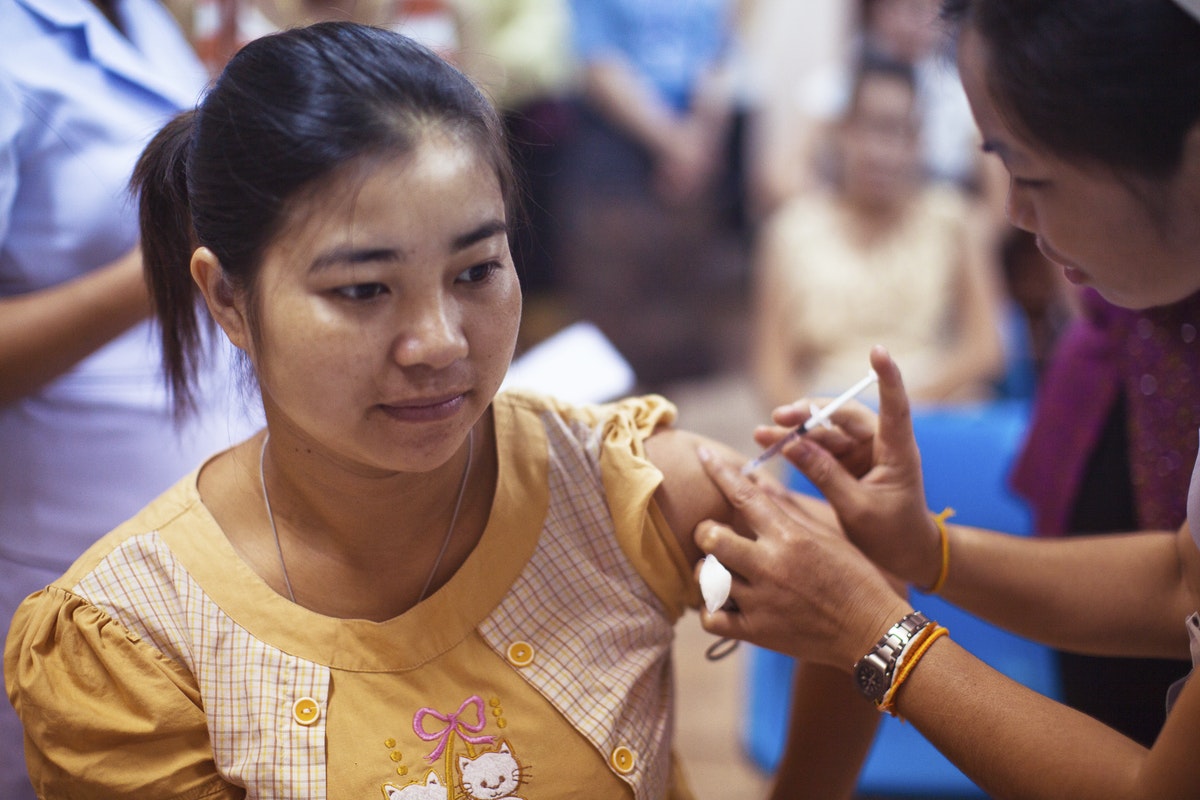
As WHO member states prepare for this major event, some are cautiously exploring possible ways to ease lockdown measures. As Tedros Adhanom Ghebreyesus, President of the WHO, emphasised in a brief message in mid-March, «test, test, test» must be at the heart of the global strategy. But this will not be enough. To avoid new waves of infection and leave behind the health risks associated with the virus, a vaccine would be another important tool. to combat the pandemic.
University laboratories and private companies are investing their efforts in developing a vaccine for COVID-19. Since the start of the pandemic, no fewer than 70 vaccines have been analysed and five are in the clinical phase. The more effort that goes into developing an effective vaccine, the greater the chance that one will be available within 12 to 18 months.
The search for a vaccine also has a less promising side. There is currently no guarantee that the vaccine will be safe and available to everyone around the world. There is a risk that private companies or powerful countries will monopolise access to it, or even seek to market an ineffective vaccine. The United States has attempted to reach an agreement with the German pharmaceutical company CureVac to secure exclusive rights to the future vaccine. Even within the European Union, Member States have been fighting over access to essential medical equipment.
Governments are providing billions of euros for vital vaccine research. It makes sense that these collective public efforts should benefit the common good.
Major pharmaceutical companies such as Johnson & Johnson, GSK and Pfizer are working hard to be the first to bring their product to market. Before the COVID-19 crisis, these companies did not show the same enthusiasm or effort that they are now putting into marketing a vaccine. In fact, after outbreaks of other coronavirus variants, such as SARS (2002) and MERS (2012), scientists were close to a major breakthrough. But at the time, scientists were met with total disinterest from the big pharmaceutical companies: without a virus, there was no question of a vaccine because there was little potential profit to be made. It can be assumed that if the main motive for producing a vaccine is profit, the needs and health of the population could take a back seat.
If agreements are not reached on the price and availability of a COVID-19 vaccine, there is a danger that the will of governments and the health of the population will be outweighed by the interests of the pharmaceutical industry. Let us remember that the enormous efforts involved in researching and developing a vaccine are largely financed by private and public investments of several billion euros. Governments are making billions of euros available for vital vaccine research. On 4 May, the EU raised €7.4 billion in a global donor marathon. The Belgian government has invested €20 million to accelerate research. It is only logical that these collective public efforts should benefit the common good.
The development of an effective and universally available vaccine against COVID-19 is one of the most crucial objectives of our time. Scenarios such as business as usual cannot be considered. Without international cooperation and solidarity, we will not be able to overcome this crisis. A global crisis requires a global approach. In the fight against this virus, it is absolutely essential that agreements be reached at a global level concerning the development and availability of a possible future vaccine.
We request that the following recommendations be taken into account in order to guarantee access to a vaccine for all:
1. Prioritise multilateral action and international solidarity
Governments, researchers and businesses must work closely with the WHO. Withdrawing financial support from the WHO, as the United States has done, is unacceptable. Proactively push for international coordination, led by the WHO, of research and development into vaccines and other essential medical products. Ensure that powerful states cannot monopolise access to the vaccine by establishing collective and public allocation mechanisms. In this way, fair and global use of a vaccine can be guaranteed.
2. Pool funding to develop the vaccine in the public domain
It is extremely important that public and private resources devoted to vaccine development are pooled so that the vaccine becomes public property and is not protected by a patent granting a monopoly to large pharmaceutical companies.
3. Consider a vaccine as a global public good free of rights
The medical products needed to test the population for COVID-19, to treat those who are infected and to vaccinate the population must be provided to governments at an affordable price. They must also be made available quickly and free of charge to all those who need them, particularly medical staff and at-risk groups. The authorities must guarantee fair prices for treatments, tests, vaccines and protective equipment. Hence the importance of strengthening social protection systems. To prevent private actors from appropriating them, work must be done to develop medical equipment free of patents. To this end, authorities can resort to compulsory licences, as set out in the World Health Organisation (WHO) TRIPS agreement, and a patent pool under the auspices of the United Nations.
4. Facilitate the sharing of developed technologies, knowledge and expertise
Science and medical innovation develop more rapidly when researchers exchange and share results. They contribute to mutual success by increasing knowledge and expertise. We must prevent crucial data and expertise from being withheld and establish a platform where intellectual property rights on technologies and know-how are invested in the public interest. We must also ensure that, in view of potential mutations, samples of the virus are constantly shared with the international community, as provided for in the Nagoya Protocol to the Convention on Biological Diversity.
5. Ensure that the development, production, and distribution of other vital vaccines are not delayed due to the focus on the COVID-19 pandemic.
The urgency of the situation is driving governments, researchers and companies to devote themselves entirely to developing a vaccine for COVID-19. However, other public health issues and the need for other essential vaccines and medicines, such as for measles, malaria, cholera and meningitis, remain. It is therefore essential to ensure the continued development, production and distribution of other vital vaccines.
Signatories:
11.11.11, CNCD-11.11.11, Viva Salud, SolSoc NGO, Street Workers Network, WSM, Monde des Femmes, Handicap International – Humanity & Inclusion, FGTB-ABVV, CM, Medecins Du Monde, Oxfam-in-België, FOS en Entraide & Fraternité