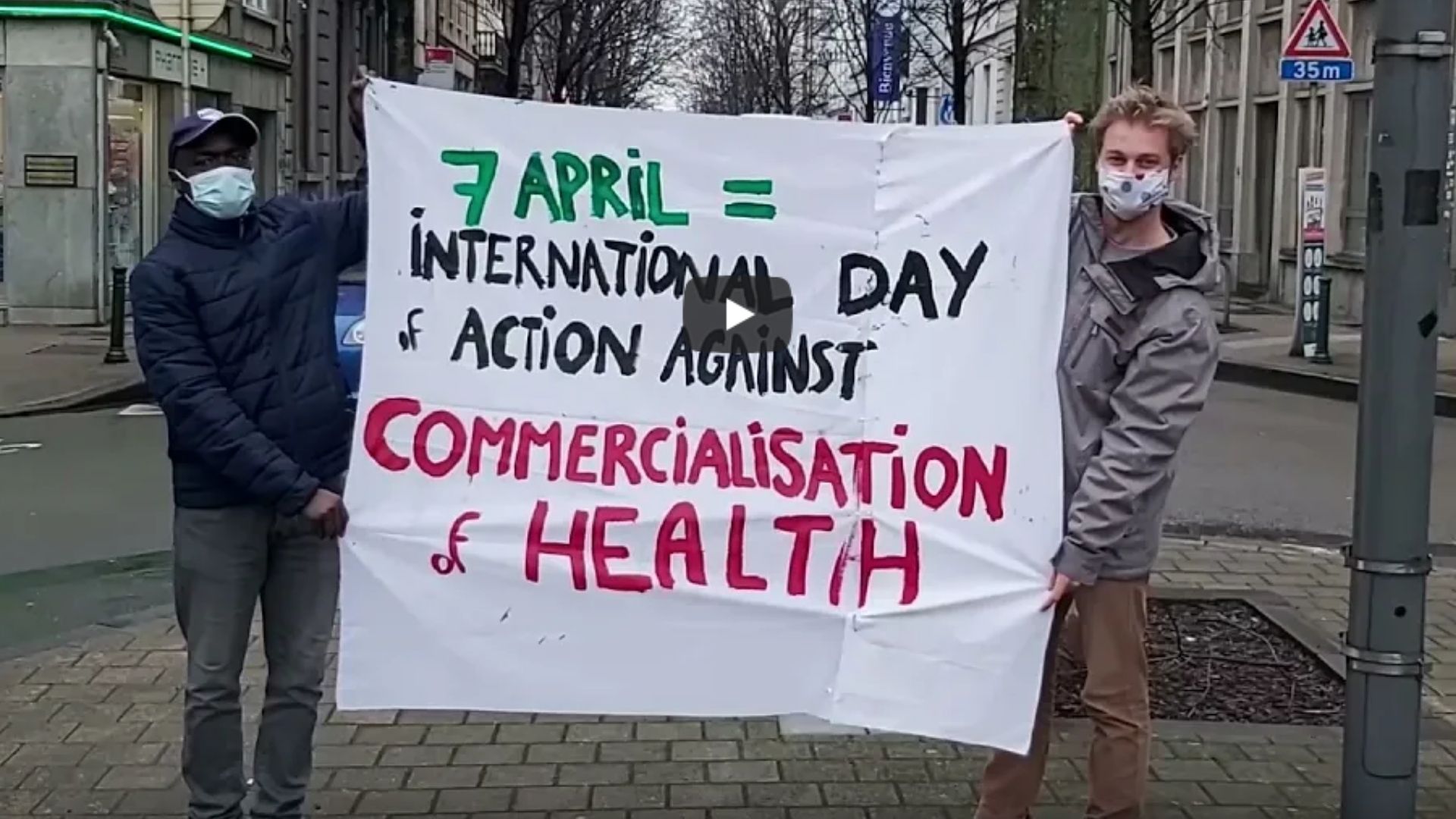
On 7 April, World Health Day, we are taking action for a strong public healthcare system and broad access to the coronavirus vaccine. On 2 April, together with dozens of other organisations, we sent a letter to the European institutions and the governments of the EU Member States. We are asking them to take action to ensure that vaccines against COVID-19 are rapidly made available to everyone, everywhere in the world.
On 7 April, World Health Day, we, a broad coalition of civil society organisations across Europe, urgently call on our governments and the EU institutions to implement a response based on global solidarity to combat COVID-19. We call for action to ensure that vaccines and medical products against the coronavirus are available to everyone, everywhere in the world. Their production must be accelerated as quickly as possible. For this to become a reality, intellectual property rights (IPR) must be temporarily suspended, and production technologies and know-how must be widely shared. We must act now to ensure that the pandemic does not go down in history as a moral failure of rich countries at the expense of vulnerable lives around the world.
More than a year after the start of the pandemic, Europe's response to the spread of the virus is inadequate. Not only has the pandemic already claimed the lives of more than 900,000 people across the continent, it has also severely tested healthcare professionals and systems. The pandemic has rightly highlighted the main weaknesses in our healthcare systems. After years of sustained cuts to public services and policies based on austerity, health systems have been caught unprepared for an epidemic of this scale, and are standing on their own two feet thanks to the dedication of the people working in health establishments.
Vaccine nationalism
One would hope that in exceptional circumstances such as a global epidemic, the logic of profit would no longer prevail over people's lives and livelihoods. Indeed, at the start of the pandemic, statements were made to this effect. Many officials, including Ursula Von Der Leyen, assured us that the COVID-19 vaccine should - and would - be treated by the EU as a global public good. Meanwhile, EU and Member State officials led us to believe that the response to the pandemic would be fuelled by global mechanisms such as the ACT accelerator, which would allow countries to access the necessary products regardless of their income.
Contrary to these initial promises, we are now witnessing the extreme nationalism defended by many Western countries when it comes to vaccines. High-income countries have monopolised 53% of the available vaccines even though they represent only 14% of the world's population, disregarding the needs of others. The amount that European countries have pledged to COVAX, the WHO-led mechanism for guaranteeing vaccines to low- and middle-income countries, while much appreciated, is far from enough to make equitable access a reality. According to the Economist Intelligence Unit, «in developing countries, generalised vaccine coverage will not be achieved until 2023, if at all».
Suspend patents, share knowledge and technologies
Not only have global solidarity mechanisms remained a dead letter due to insufficient funds and vaccine nationalism, but the equitable distribution of vaccines has been hampered by high-income countries within the WTO. The UK, Norway, the US and the EU are still among the few countries blocking a proposed waiver to certain aspects of the TRIPS agreement submitted by India and South Africa in October 2020. The proposal would allow countries to choose not to grant or enforce patents and other intellectual property rights (IPRs) related to COVID-19 products such as medicines, vaccines, masks and ventilators during the pandemic. This would provide the legal space to collaborate on the research and development, manufacture, scale-up and distribution of COVID-19 solutions, such as vaccines.
A temporary suspension of IPRs is the only way to increase production and widen access to vaccines quickly. Relying on tools such as compulsory licensing, which the EU is advocating at the WTO, will not achieve the same result. We know from experience that the introduction of such licences can take years, and we must question whether they can be implemented in this context, given that on previous occasions the EU has strongly criticised other countries for relying on compulsory licences.
Finally, not only must we temporarily waive these IPRs, but our governments must also demand that knowledge about the production of COVID-19 vaccines be shared by manufacturers. A pandemic is not a time for industrial secrecy. The EU has a moral imperative to take action in line with public demand: recent surveys have shown that on average 69% of people in Western countries believe that governments should ensure that vaccine science and know-how is shared with qualified manufacturers around the world.
Global solidarity and international collaboration
The European Union has made huge investments in vaccine research, development and production, enabling the introduction of vaccines to be accelerated in unprecedented circumstances. Despite this, we have seen that the European institutions placed no conditions on these massive investments granted to Big Pharma: they signed non-transparent agreements (highly profitable for these multinationals, which acquired patents on vaccines instead of making them a global public good), keeping no control over who would have access to these publicly-funded goods, at what price and when.
That's why, on this World Health Day, we are supporting the European citizens' initiative Right to Cure, which addresses all these concerns through concrete demands to the European Commission. COVID-19 has become a huge and lucrative business, costing us our health and the lives of many people around the world. The EU institutions and the governments of European countries must now shoulder their responsibilities and reshape their response to the coronavirus pandemic, ensuring that vaccines are available to all and that the interests of pharmaceutical companies do not come before the health of the people. Only a global response, based on global solidarity, will be effective in combating this pandemic.
Signatories
78 organisations in Europe signed the letter. In Belgium, they are the following organisations:
ACV Puls, Agora des Habitants de la Terre, BBTK Federaal, Belgian Anti-Poverty Network (BAPN), C.B.C.S., Centre familial de Bruxelles, CETRI - Centre tricontinental, CGSP ALR-LRB BRUXELLES, Christelijke Mutualiteit, CNE, Cultures&Santé, FARES asbl, Fédération Wallonne de Promotion de la Santé, Femmes et Santé, Geneeskunde voor het Volk, La santé en lutte, le Monde selon les femmes, Links Ecologisch Forum, ManiFiesta, Médecins Sans Vacances / Artsen Zonder Vakantie, Mouvement Ouvrier Chrétien (MOC), Mutualités chrétiennes, Plateforme d'action pour la santé et la solidarité / Actieplatform Gezondheid en Solidariteit, PSMG, PTB-PVDA, QUINOA ASBL, SETCa Non Marchand, Solidaris, Théâtre de Galafronie, Union Nationale des Mutualités Libres, Viva Salud, WSM.
Sign the European Citizens' Initiative
Put pressure on the European Commission to ensure that Covid-19 vaccines are rapidly made available to everyone, everywhere in the world. Sign the European Citizens« Initiative« No profit from the pandemic« .