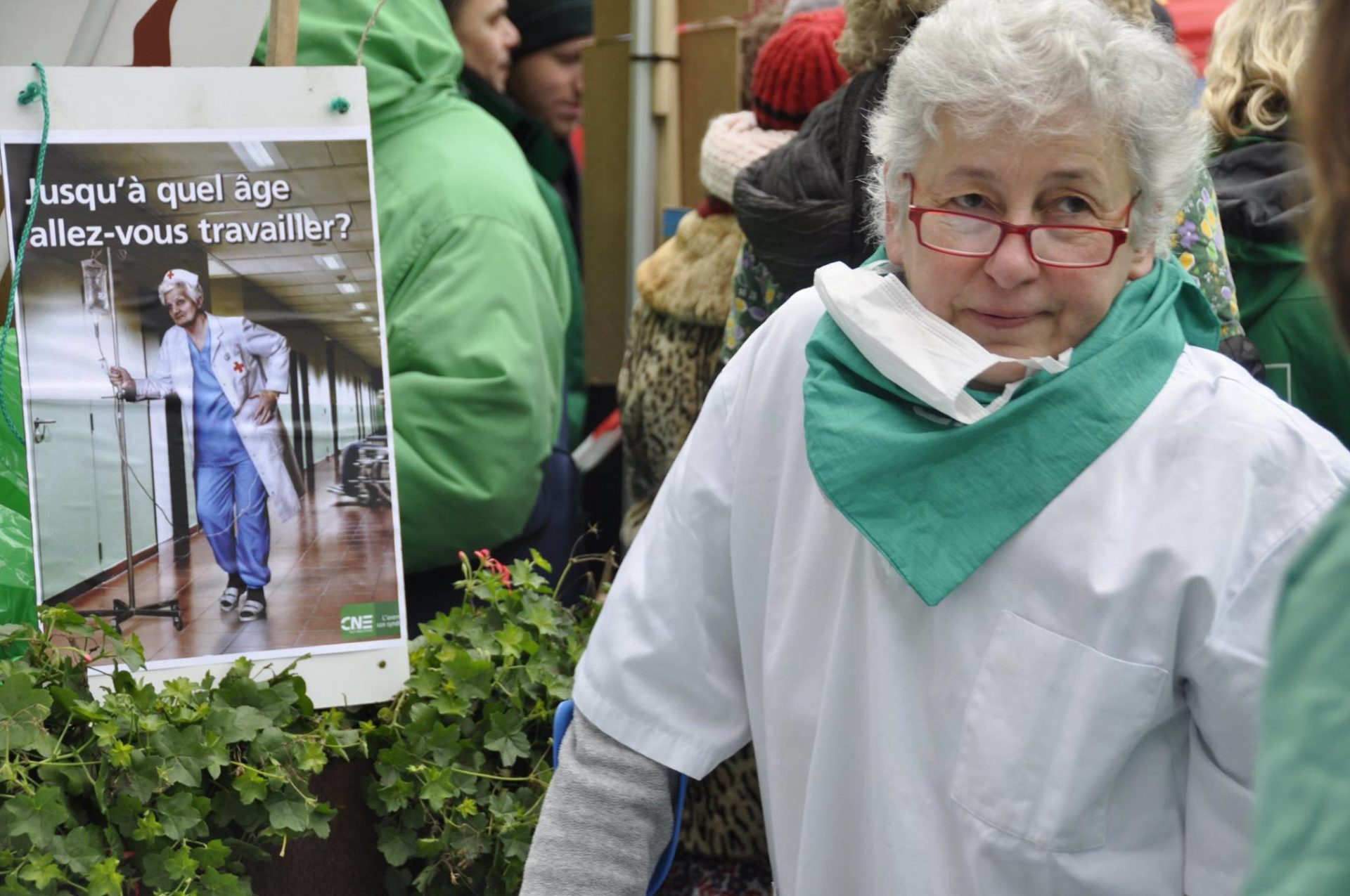
Marie-Agnes Gilot works at the Centrale nationale des employés (CNE) for the non-commercial sectors. She is particularly active in the European network against the commercialisation of healthcare. We asked her about the trade unions' position in the No Profit on Pandemics campaign.
Why are Belgian trade unions supporting the European citizens' initiative No Profit on Pandemics?
«We are clearly in favour of healthcare that is accessible to all. Health in its global sense, which takes into account all the determinants of health. This is the aim of the work of the European Network to Combat the Commercialisation of Health, and of the CNE within this network.
As players in the healthcare sector, we are trying to move things forward so that the entire world population has access to the vaccine needed to overcome the pandemic. The fight to lift patents is an integral part of this approach.
The idea is to fight neo-liberal policies, where «whoever has the money can have access to everything and too bad for the others». It's clearly a trade union battle that fits in with our project for a more inclusive, egalitarian and participatory society at all levels and in all sectors. Although I'm speaking on behalf of the CNE, I think that the other Belgian unions are broadly in line with these ideas.»
How are trade unions driving this campaign forward? What role are union activists playing?
«Every year on 7 April, World Health Day, the European network takes action to combat the commercialisation of health. This year, it seemed logical to us to support the European Citizens' Initiative No Profit on the Pandemic.
At union level, we tried to promote the campaign in health care institutions. The essential role of activists is to inform workers, whether affiliated or not, and also users. The aim is to disseminate the information as widely as possible, in particular via our sectoral brochure.
We had asked the staff to set up stands to inform visitors and patients and invite them to sign the European Citizens' Initiative. Unfortunately, this proved too complicated given the health standards in the care facilities. Nevertheless, they publicised the campaign. We are also relaying it to the national and international bodies in which we participate.
We're trying to do something positive with contamination!»
Has this battle for affordable medicines lasted longer than the pandemic?
«Yes, of course. Since the network was created in 2012, this has been a major concern. We have 6 areas of work. One of them is the issue of drugs and Big Pharma. This can be seen in the network manifesto, written in 2014, in which we denounced commercialisation and explained its mechanisms.
In 2018, we had already put the accessibility of medicines at the centre of our main annual action. As part of the Tam-Tam campaigns, people took over the Pharma.be offices to raise awareness of the importance of access to medicines. the famous «Article 81», the rather murky text that protects Big Pharma. We also took action before Parliament.
In 2019, in the run-up to the European elections, we held a conference in Parliament. We invited members of parliament to sign a declaration of principle so that they can commit to denouncing and fighting the commercialisation of health at European level.
And in 2021, we ran the No Profit on Pandemics campaign with the Right2Cure platform.
So it's something we've been trying to denounce and fight for several years.»
Is this a joint struggle with unions from all over Europe?
«The CNE is a member of EPSU, the European Federation of Public Service Unions. Here too, we are working to raise awareness. We are trying to put the privatisation of health systematically on the trade union agenda, to get things moving collectively.
The trade union focus is primarily on the workplace and workers. But at European level, we are talking about a broader political level where both workers and all citizens can have an impact! We know that Europe tends to hide behind its lack of competence in health matters. But this is changing. With the pandemic, the debate has become a little more open and it seems that the question of Europe's competence in health matters could be broadened. We will be following this closely.
So we have to work on both sides at the same time: on the health of workers and on the commercialisation of institutions, but also on health policy at European level. And that's the whole point of the work we're doing at Network level. We need to work with parliamentarians to get their foot in the door so that all European policies include health aspects in their discussions. Health cannot be seen as something separate.
Since we started, between 2013-2014 and now, we feel that we are managing to have an impact. Even when it comes to the vaccine campaign, the political lines are moving. We think it's important for unions and associations to work together, because we can't do it on our own. We need to join forces!»
Read also
Read other articles and interviews on the same theme on our website:
- The pandemic is not over. Let's change it!
- Minister De Croo, make the vaccine a public good
- If only COVAX had chosen to break Big Pharma's monopoly, interview with PHM expert Prasanna Saligram
- The West isolated on the issue of lifting patents, an interview with Marc Botenga, Member of the European Parliament