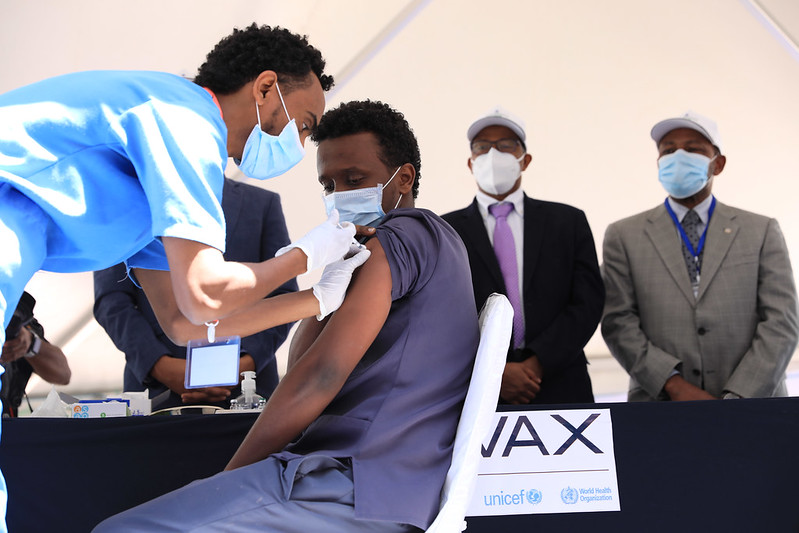

Governments around the world have promoted COVAX as the magic solution to the pandemic. But while Big Pharma is making billions, the device is struggling to fulfil its modest ambitions. We spoke to expert Prasanna Saligram of the People's Health Movement (PHM) to find out more about the role and challenges of COVAX.
What is COVAX? Why was it set up?
«Historically, whenever there has been an epidemic, there have been inequalities in access to essential medicines and vaccines. For example, with the H1N1 virus in 2009, a vaccine was developed but high-income countries (HICs) acquired all the vaccines. So for COVID-19, we needed a global mechanism to distribute vaccines to low- and middle-income countries. The main mechanism for achieving this is the COVID-19 Accelerator (ACT-A or ACT Accelerator). It has four arms: one for vaccines, one for diagnostics, one for therapeutics and one for health systems. The vaccine branch is called COVAX and aims to accelerate access to COVID-19 vaccines.»
Who runs it?
«If you read the media, you will understand that COVAX is an initiative led by the World Health Organisation (WHO). In reality, it is not led by the WHO. It is a public-private partnership led by two organisations: Gavi (the Vaccine Alliance) and CEPI (Coalition for Innovations in Epidemic Preparedness). Both are multi-stakeholder public-private initiatives funded and supported by the Bill & Melinda Gates Foundation. The WHO and UNICEF are also associated with COVAX as multilateral organisations, but they have no decision-making power. Although excluded from central governance mechanisms, WHO and UNICEF second staff and give legitimacy to COVAX. The real decision-makers remain the CEPI and Gavi, as well as the international pharmaceutical industry, which also sits on the governance body».»
What is it aiming at?
«COVAX is presented as a global solidarity platform, but the problem is that it was proposed immediately after another initiative that was much more ambitious. an international platform, C-TAP (COVID-19 Technology Access Pool). C-TAP is a WHO initiative to organise the sharing of knowledge and technologies. However, as most of the major pharmaceutical companies want to retain their profits, they have been unwilling to share their knowledge and patents. This is where COVAX comes in. Its approach remains based on market logic. It acts as a volume buyer to negotiate better prices for high-income countries (HICs) and to provide free vaccines to low-income countries for their priority population. According to the WHO, priority groups such as health workers, vulnerable groups and the elderly represent around 20 % of the population. COVAX has therefore promised to deliver enough vaccine for 20 % of the population. But, as we know, to achieve sufficient herd immunity to stop the spread of the disease, 70 to 80 % of the population need to be vaccinated. How will we bridge the gap between 20 % and 80 %?»
Will COVAX achieve its objectives?
«We can see that COVAX is really in trouble. Countries like Venezuela are complaining that they gave money to COVAX without receiving any vaccine. So there are questions about effectiveness. COVAX was supposed to supply 2 billion doses by the end of 2021. It is now July 2021 and it has barely distributed 83 million doses. COVAX claims to have delivered to many countries around the world. In reality, a large proportion has gone to the EPRs, which are also part of the COVAX programme but which do not need additional vaccines. So we can see that the EPRs are better served than the poorer countries, who were led to believe that COVAX would take care of them. Instead, they are all left waiting.»
What are the biggest challenges for COVAX?
«The biggest problem is that it depends on charity instead of taking a solidarity-based approach. If COVAX had chosen to break Big Pharma's monopoly, it would have been much more effective. There would have been many more manufacturers and perhaps we wouldn't have to ship vaccines from one continent to another. Moderna obtained around 8 billion US taxpayers» dollars to develop and produce its vaccine. But Moderna is also the most expensive vaccine, at around $31 a dose. And COVAX blindly pays this price. This means that COVAX has not obtained better prices. COVAX has never announced that it wants to limit Big Pharma's thirst for profits or encourage companies to share their technologies. In fact, it has done nothing of the sort. It is content to follow the logic of the market without touching the patent model. This can only lead to bad results, as we have seen with vaccine nationalism and global vaccine apartheid".»
Is COVAX the magic solution to the pandemic as described?
«When social movements and activists lobbied their trade and health ministers to put vaccines into public hands, they were told that COVAX would facilitate global access to vaccines. Governments believed that donations for COVAX would flow quickly and that pharmaceutical companies would be queuing up to deliver their vaccines to COVAX. None of this happened. Donations fell short of expectations. What's more, companies like Pfizer and Moderna are too busy supplying the ERPs to feed COVAX. Even Astra Zeneca is not delivering as promised. In this age of vaccine nationalism and profit-hunting, COVAX doesn't stand a chance of honouring its commitments. Charity doesn't get you very far. We need an approach based on global solidarity and human rights.»
What does the People's Health Movement propose?
«PHM's proposal is based on three points. First and foremost, the TRIPS waiver (Agreement on Trade-Related Aspects of Intellectual Property Rights) must be adopted immediately. Intellectual property barriers must be removed so that we can rapidly step up production. Next, we need to strengthen C-TAP. It was designed on a voluntary basis but should be strengthened to facilitate genuine technology sharing. Finally, we need to ask ourselves why we are no longer investing in public research and development? If you look at the development cycle of any technology, vaccine or drug, you see that the basis is always developed in public universities. It's only at a later stage, during clinical trials for example, that we see greater involvement from the private sector. So, if so much public money is being spent and if the innovation is coming from the public sector, why not promote more public research and development? Of course, with PHM, we're also looking to strengthen local manufacturing capacity. If not for this pandemic, at least for the next one.»
Read also
Read other articles and interviews on the same theme on our website:
- An independent study on the coronavirus pandemic points the finger at Europe
- The pandemic is not over. Let's change it!
- Minister De Croo, make the vaccine a public good
- Positive contamination of the trade union movement, interview with M-A Gilot, CNE
- The West isolated on the issue of lifting patents - an interview with Marc Botenga, Member of the European Parliament