The Belgian government wants to improve global access to vaccines through a charitable strategy. However, according to 24 Belgian organisations (see below), this will not be enough.
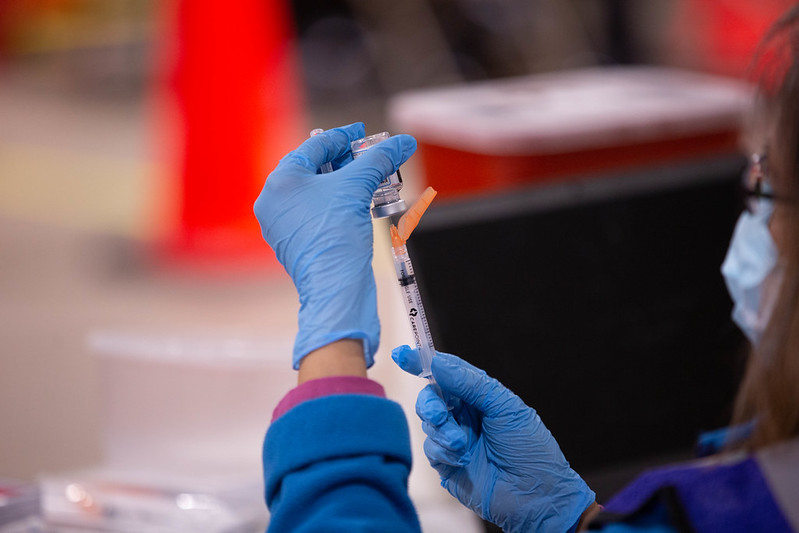
On Monday 27 September, the Minister for Development Cooperation, Meryame Kitir, visited Liège Airport to mark the departure of a consignment of coronavirus vaccines, destined for low-income countries via the mechanism COVAX. The initiative is understandable, given his role as Minister for Development Cooperation, but it will not change the global vaccine apartheid. Just like the weak resolution passed by the Vivaldi majority in the Federal Parliament on 23 September. Charity and empty rhetoric are at the forefront of our government’s strategy. However, this will not help us overcome the pandemic.
The gap between the rich and the poor remains enormous. In the 29 poorest countries, home to around 9% of the world’s population, barely 0.3% of the total number of vaccines has been delivered. Across the whole of Africa, less than 4 % of the population has been fully vaccinated. The global vaccination campaign is therefore a failure across the board.
The coronavirus has free rein
Every day, between 6,000 and 10,000 people worldwide are still losing their lives to Covid-19. The World Health Organisation is currently monitoring six different variants of the virus. These could also pose serious problems. In an international survey carried out earlier this year, two-thirds of the virologists questioned warned that current vaccines will not provide protection against new mutations of the virus emerging over the coming year. This figure can only be interpreted as a clear warning of the urgent need to bring the pandemic under control worldwide as quickly as possible.
Our government and the leaders of other wealthy countries claim to be pursuing this objective. At the United Nations General Assembly, one promising statement followed another. On 24 September, US President Joe Biden presented himself as a benefactor on the world stage, promising 500 million additional vaccines to speed up the global vaccination campaign. Our Prime Minister, Alexander De Croo, for his part, stated that vaccine solidarity is an essential condition for overcoming the pandemic. But let’s be honest. A donation of 4 million vaccines is merely a drop in the ocean on a global scale.
Too little, too late
Above all, it is too little, too late. Moreover, this pledge lacks credibility: the vast majority of previous pledges have not yet been fulfilled. Barely 15 % of the billion doses that high-income countries pledged to donate have reached Africa. COVAX, the mechanism aimed at vaccinating healthcare workers and vulnerable groups in low-income countries this year, is half a billion doses short of its already modest target. Worse still, the EU is importing more vaccines from Africa, in net terms, than it is donating. Indeed, research carried out by the New York Times shows that Johnson & Johnson put pressure on the South African government to export vaccines to the EU.
A goldmine for Big Pharma, a public health disaster
Meanwhile, the pharmaceutical industry’s profit model remains intact. Whilst leaders of rich countries were making grand statements about international solidarity, the big pharmaceutical companies were seeing their turnover reach record highs. Thanks to their monopoly on coronavirus vaccines – the development of which was supported by $100 billion of taxpayers’ money from various countries – Moderna, Pfizer and BioNTech generated over $26 billion in sales in the first half of 2021. For Moderna and BioNTech, two-thirds of this amount is pure profit. According to the People’s Vaccine Alliance, at least nine people have become billionaires thanks to the pharmaceutical industry’s enormous profits since the start of the pandemic.
Thus, Big Pharma’s business model – receiving billions of euros in public funds, charging exorbitant prices for life-saving medicines and paying little tax – is a goldmine for investors and corporate executives. But it is a disaster for global public health. It is plunging certain regions of Latin America, Africa and Asia into new crises, pushing weakened health systems to the brink of collapse and causing tens of thousands of preventable deaths every week. According to Amnesty International, Big Pharma is fuelling an unprecedented human rights crisis. It is therefore urgent that we adopt a different approach. False promises and charity have no place here.
Putting the vaccine in the hands of the public
At the United Nations General Assembly, Spanish Prime Minister Pedro Sánchez was clear about the first step. In his view, «we must resolve the bottlenecks in the production and distribution of vaccines, in particular through a temporary waiver of patents on coronavirus vaccines». Our government should support this call in Europe and join the hundred or so countries that are advocating the TRIPS waiver.
Through the European Citizens« Initiative »No Profit from the Pandemic’, 31,000 Belgians are already calling for COVID-19 vaccines to be made available to the public. Next, we must focus on knowledge and technology transfer. In this way, we can rapidly scale up vaccine production. And in the long term, we will strengthen the development of local production facilities worldwide. These measures will enable production to be tailored to local health needs. They will make the population less dependent on the profit-seeking of Western pharmaceutical companies. Which, after all, is no small matter in a pandemic situation.
The European Citizens’ Initiative ‘No Profit from the Pandemic’ aims to collect one million signatures across Europe to compel the European Commission to take action and make the coronavirus vaccine available to the public. You can sign the initiative here: https://noprofitonpandemic.eu/fr/
Signatories:
- Wim De Ceukelaire, Viva Salud
- Jean Hermesse, Health & Solidarity Action Platform
- Yves Hellendorf, non-commercial CNE
- Bart Verstraeten, WSM
- Elies Van Belle, Memisa
- Stefaan Bonte, Doctors Without Holidays
- Elisabeth Degryse, Mutualité Chrétienne
- Ariane Estenne, Christian Workers’ Movement
- Karim Zahidi, Masereel Fund
- Koen Meesters, LCA
- Koen De Maeseneir, VWGC
- Filip De Bodt, Climaxi vzw
- Michel Vanhoorne, FGE
- Mario Franssen, ManiFiesta
- Nina Henkens, Kif Kif vzw
- Anne Delespaul, Medicine for the People, European Citizens’ Initiative: No Profit from the Pandemic
- Hélène Debaisieux, Quinoa
- Marijke Persoone, Something Completely Different
- Christine Mahy, Walloon Network for the Fight against Poverty
- Yahyâ Hachem Samii, Brussels Mental Health League
- Céline Nieuwenhuys, Federation of Social Services
- François Perl, Solidaris
- Nathalie Lionnet, SETCa
- Beweging.net