Over 75 years of occupation
For more than 75 years now, Palestinians have been subjected to occupation, violence and systematic oppression by Israel. This brutal occupation takes all types of forms: illegal settlements that mercilessly spread across Palestinian territory, a murderous blockade of Gaza, repeated military attacks, massive and arbitrary arrests, organised theft of land and the building of an apartheid wall that divides and humiliates. This machine of oppression is turning the daily lives of millions of Palestinians into a permanent nightmare and depriving them of their most basic human rights: healthcare, education, work and decent housing.
Gaza, this tortured territory, has become «the largest open-air prison in the world». More than two million people are surviving under a criminal blockade that deliberately starves them, depriving them of drinking water, food, fuel and vital medical care. Since October 2023, this population has endured an unprecedented massacre: indiscriminate bombings, devastating military operations that have killed tens of thousands of innocent lives and destroyed hospitals, schools and homes. A true genocide is unfolding before our very eyes.
In the West Bank, oppression has been increasing daily since October 2023. Palestinian communities face ethnic cleansing: forced evictions, house demolitions, murderous raids by settlers protected by a complicit army, a suffocating military grid. Every checkpoint, every roadblock is a new humiliation, isolating families, preventing children from going to school and the sick from seeking treatment.
our commitment to our partners
We must say it loud and clear: what is happening in Palestine is not a «humanitarian crisis» that has come out of the blue, but the logical outcome of a racist colonial project. A system of apartheid methodically organised to erase a people from its own land. As long as this machine for crushing human rights is not dismantled, as long as the international community turns a blind eye to this blatant injustice, the Palestinians will continue to be deprived of freedom, dignity and the fundamental right to self-determination on their own land.
Faced with this dramatic reality, our three partner organisations on the ground - two in the West Bank and one in Gaza - are courageously continuing their daily fight for access to healthcare and the defence of Palestinian rights. Despite facing impossible obstacles, they are organising and resisting. It is vital to support them so that the Palestinians can continue their legitimate fight for freedom. Their exceptional work in these extreme conditions deserves to be known and supported.
our Palestinian partners
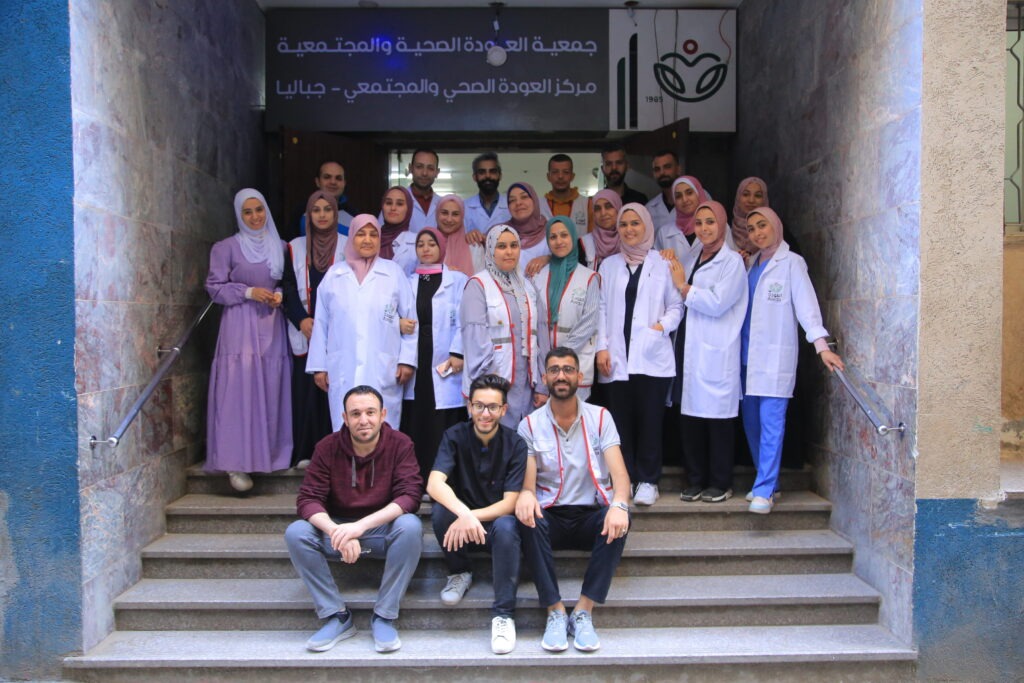
AWDA (Al Awda Health and Community Association) is a Palestinian health organisation based in Gaza, founded in the 1980s by Palestinian health professionals and activists. Its mission is to make basic healthcare accessible to everyone, particularly the most vulnerable communities in the Gaza Strip. Before the current genocide began, AWDA ran six health centres and two hospitals in Gaza. At the time of writing (August 2025), only one hospital remains operational, and two field hospitals have been built to cope with the massive influx of wounded and sick. Despite the shortage of medicines, electricity and medical equipment, AWDA continues to provide care and save lives.
AWDA provides primary care, specialist treatment, reproductive health care and emergency assistance during Israeli attacks. Much of their work focuses on women's health, including antenatal care and sexual and reproductive rights programmes. The organisation also works with young people, particularly through psychosocial support and awareness-raising programmes.
For AWDA, health is more than just the absence of disease; it is a right that goes hand in hand with social justice. This is why the organisation also carries out awareness-raising, mobilisation and community-building activities, with the aim of making the Palestinian population stronger and more resilient in its fight against occupation and oppression.
The Bisan Center for Research and Development was founded in 1989 in Ramallah, the capital of the West Bank. Its mission is to strengthen Palestinian society and make it more resilient through research, training and collaboration with civil society. Bisan conducts research on crucial issues such as the impact of the Israeli occupation, gender inequalities, social and economic inequalities, and the consequences of international development aid policies. Its analyses are used in particular by Palestinian organisations and movements to develop strategies that meet the real needs of the population.
Bisan supports around sixty local initiatives and communities in the West Bank and works with youth organisations, women's associations and trade union initiatives. Another key aspect of their work is to strengthen the position of women and young people in Palestinian society. The organisation implements projects for economic empowerment, political participation and social emancipation.
Health Work Committees (HWC) is a Palestinian NGO that has been active in the West Bank since the 1980s. Their mission: to guarantee the right to health for all Palestinians, with particular attention to the communities most affected by the Israeli occupation and structural inequalities.
HWC offers basic healthcare, reproductive health services, vaccinations and preventive care. The organisation runs a network of 10 health centres and mobile clinics, mainly in hard-to-reach areas of the West Bank. As a result, even remote villages, often neglected by the Palestinian Ministry of Health, have access to essential services.
For HWC, health goes far beyond medical care. The organisation links health, human rights, gender equality and social justice. HWC is developing programmes to raise awareness of women's rights, psychological support for young people, and initiatives that make the impact of occupation on mental health visible.
In addition to medical care, HWC also supports economic and social emancipation programmes. The organisation provides training in leadership, political participation and community organisation, with a particular focus on women and young people.