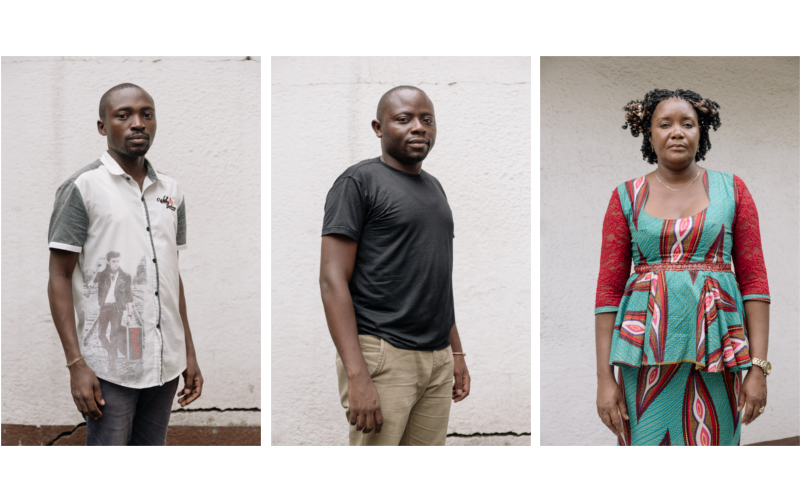
Why did Billy, Roger and Sylvie become health activists with our partner organisation Etoile du Sud? Who inspired them and how has their life changed since becoming activists?
We asked three questions to Billy (31 years old and president of the youth group), Roger (35 years old and assistant accountant) and Sylvie (45 years old and chair of the board of directors).
Who gave you the idea to become a health activist?
Roger: «I was initially active in Filimbi, a youth group fighting for change across the African continent. Unfortunately, following a change in the organisation's vision, I no longer felt at home there. I am an avid reader, and Billy from EDS explained to me that I could borrow books from their library free of charge. There, I discovered the fight for the right to health, and I have been interested ever since. When I attended the EDS conference, the coordinator noticed me. We talked about politics and health. In 2014, he asked me if I wanted to become his personal assistant, and I accepted.»
Billy: “A friend convinced me to attend meetings of an EDS branch in Barumbu, at “Maman Henriette’s”. At the second meeting, with the chair of the local EDS branch, we discussed the electricity problem in my street. And I promised her without further ado to put my new knowledge into practice.”
Sylvie: “As a contributor to the Observateur newspaper, I wrote reports on cultural and development activities. That is how, in 2009, I discovered EDS during one of their public events. The volunteers from the popular health committees told me about the difficulties they encounter in the field. The EDS facilitators suggested that we work with the local authorities and leaders to solve our problems. I was very impressed by their approach and continued to follow their activities. After a while, a coordinator asked me to work part-time for EDS as a communications officer.”
When did you realise that you could play a role in the fight for the right to health?
Roger: “When I moved into my current flat, I realised that there wasn't a single rubbish bin in any of the 14 (!) flats. Everyone was throwing their rubbish onto the street, in front of the entrance gate. I started by raising my neighbours' awareness of the hygiene problems associated with rubbish lying around everywhere, but they didn't hear my message. One day, a child playing in front of our entrance started eating the rubbish. He became very ill.
Suddenly, everyone listened to me. The landlord forced everyone to put their rubbish in a bin. We organised a collection system for which each resident paid their share.
I realised that I could have a positive impact on my neighbourhood, and since then I have continued to develop my involvement in my street and then throughout my entire neighbourhood.”
Billy: “I discovered that the electrical cable that was supposed to supply power to my street was faulty. Not very safe, then. My newly acquired knowledge about empowerment made me realise that I too was responsible for my living conditions. I gathered some young people from my street and we discussed how we could solve this problem. We wrote a letter to the national electricity company, the national parliament and the Ministry of Energy. Local officials signed the letter, as did the chair of our people's health committee and ourselves. A week later, early in the morning, we suddenly saw workers from the electricity company delivering a new cable. Fearing it would be stolen, we helped them bury the cable as quickly as possible.»
Sylvie: “As an EDS employee, I regularly visited the field to learn more about their achievements and the context. I was fascinated by the many volunteers who selflessly devote themselves to their community. They fight against erosion, child malnutrition and poor living conditions. At the time, I was still working part-time for the newspaper and I talked more and more about EDS to my colleagues. I launched my own health campaigns there and was even nicknamed “Maman Bopeto”, after the door-to-door waste collectors. Combining my two jobs became too much, so I ended up opting for a full-time position at EDS.”
How has your life changed since you became a health activist?
Roger: “When I was studying international relations, I wanted to become a diplomat in Uganda. I did an internship at the Congolese embassy there. Now I work as an assistant accountant at EDS. So my life has taken a completely different direction. Thanks to training at EDS, I now know how to tackle specific problems in my neighbourhood and who to contact to bring about real change. I can see that my commitment is having a lasting impact, and I'm proud of that!”
Billy: After our campaign for safer electricity, I and other young people founded a neighbourhood committee to address our problems. The whole neighbourhood is now aware of this initiative. Men and women, adults and children, everyone is participating in our solidarity actions. In the meantime, I have turned my commitment into my profession and am now president of the EDS youth movement.”
Sylvie: “I was already working on development issues at L'Observateur. But it was only when I discovered Etoile du Sud that I really saw the positive impact of health activism. I don't regret my decision to get involved with EDS for a moment.”
Would you like to support Billy, Roger and Sylvie in their fight for the right to health? You can do so via an online donation for Viva Salud. Would you like to support their activism with a monthly donation? Become an ally of Viva Salud.