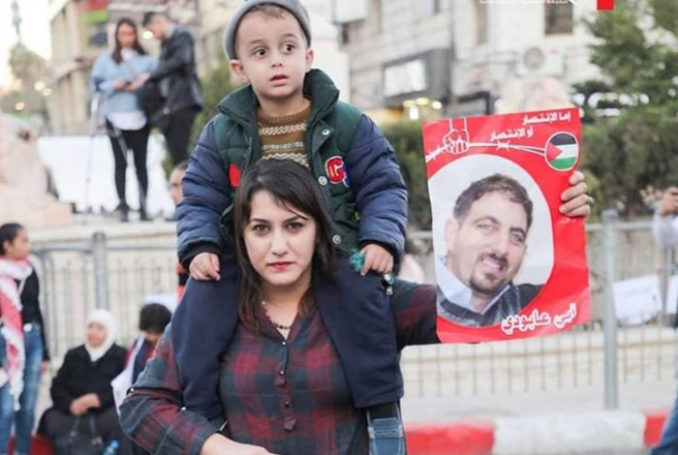
On 14 November 2019, we learned that our friend and colleague Ubai Aboudi, director of the Bisan centre for Research and Development, had been arrested at his home in the middle of the night. In front of his wife and 3 little boys. After 11 months in Israeli jails, Ubai is free again. Read Ubai's exclusive interview about his experience in prison and learn from his extraordinary strength.
It's so good to see you Ubai. How are you? How are Hind and the children?
Better than ever. I'm full of energy, maybe even more than before prison [Laughs]. I'm happy to be back with Hind and the kids, I missed them terribly. It's been very hard for them. Hind has taken on the role of father and mother in our home. She's done an incredible job. The children have grown up so much. And this experience has left its mark. They haven't let me out of their sight for the last 2 weeks.
What have you been doing since your release?
First I enjoyed my family, receiving lots of visits and calls. Then I quickly returned to Bisan to work. I needed to keep up to date and continue to support the centre's important work with the communities most affected by the consequences of the Israeli occupation.
Did your arrest have an impact on Bisan's work?
Yes. When I was arrested, we were in discussions with several international organisations and donors about setting up development programmes. Some of them were afraid and backed away, preferring not to be linked with Bisan in these circumstances. The occupation said so many horrible and untrue things about me in the newspapers. They accused me of unimaginable things and I had no control over that. We lost a lot of potential financial resources because of this false propaganda. The Bisan website was also hacked and it took several months to update it.
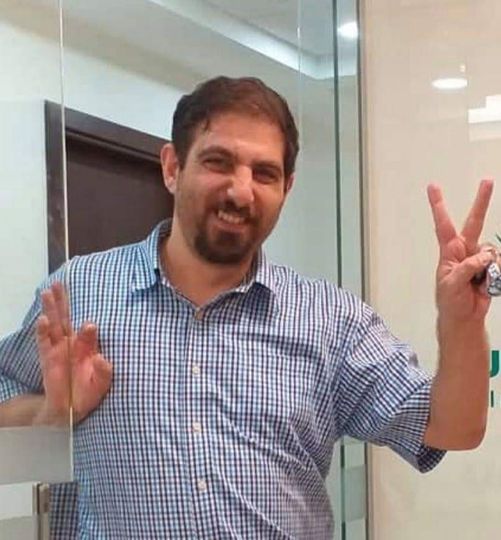
With my arrest and that of my other colleague Salam the previous year, Bisan also faced a serious shortage of human resources. Hanan took over as interim director. She's been great and I feel like I'm no longer needed [Laughs]. I'm surrounded by incredible women.
Fortunately, other partners proved to be invaluable supporters in the face of the Israeli attacks on me and Bisan. This was the case with Viva Salud, which made numerous gestures of solidarity and gave unfailing support to Bisan and my family. I was very touched.
My arrest is part of a strategy of systematic harassment of progressive left-wing voices within the Palestinian social movement. The occupation targets individuals and social organisations and tries to discredit them and tarnish their reputation in international networks. Israel does not want us to expose the human rights abuses and violations they have instigated. Bisan has often been the target of harassment in the past, whether by the occupation, the Palestinian Authority or big business. But that doesn't stop us from doing our job: exposing violations of the human and socio-economic rights of the Palestinian people.
Can you explain why you were arrested?
I was arrested on the night of 13 November. It was 3am when Israeli soldiers knocked on our door. My children were terrified. The soldiers told me I was under arrest without telling me why and dragged me straight to a military jeep in the street. I barely had time to say goodbye to my family. I spent hours in pyjamas, in cold rooms, without eating and without knowing where I was or what was going to happen to me. A few days later, I received my sentence: 3 months' administrative detention.
Can you explain what administrative detention is?
This is a technique inherited from the British Mandate. Israel uses it illegally and abusively, through mass arrests of Palestinians on the basis of no known charges, renewable ad infinitum. Some prisoners have spent more than 5 years in administrative detention. Worse still, some have served more than 20 non-consecutive years without ever knowing why.
This technique is used as a means of oppressing the Palestinian people and it is also psychological torture. You never know when you will be arrested or for how long. They want to break down resistance to their system of apartheid and colonisation.
You weren't always in administrative detention during your imprisonment; there was a trial in May 2020.
That's right. A real farce. I think the shabak - the Israeli internal security services - had to find another way of keeping me in prison. There was a lot of international pressure and I also have dual American nationality. So they brought charges against me and transferred me to a military court.
In an Israeli military court, you have to prove that you are not guilty. 97% of trials of Palestinians in military courts end in a guilty verdict.
The accusations were pure lies and based on no valid evidence. My lawyer never had access to this evidence to prepare my defence. During the trial, we learned that the only charges against me were based on torture sessions on other Palestinian prisoners, which is not only unsound but intolerable. In Belgium, I believe that an accused person is presumed innocent until proven guilty. In an Israeli military court, you have to prove that you are not guilty. This has nothing to do with a court of law and everything to do with illegality.
When I was in prison, I read the biographies of Nelson Madela, Malcolm X and also Huey Newton, co-founder of the Black Panther movement in the United States. I felt a powerful connection because, like the black community in the United States, Palestinians are judged guilty before they even go to trial. You know you're going to be found guilty. 97% of trials of Palestinians in military courts end in a guilty verdict.
Can you tell me more about your months in prison?
Prison is all about camaraderie and solidarity, but it's also about an immense sense of oppression at the hands of a system that tries to dehumanise you. Oppression because the incarceration system does everything it can to break you down: denial of visits, insufficient food, pepper spray, physical beatings, humiliation, confiscation of personal belongings such as photos, denial of access to education and telephone calls to family.
One of the main feelings I had as a prisoner was the deprivation of human contact, especially with my family. I wasn't allowed to even touch my wife Hind's hand because visits were made behind glass. Only my children were allowed to hug me, but only for 10 minutes and only every 60 days. With the coronavirus, some visits have even been cancelled, not to mention the sanctions linked to our resistance movement to demand greater protection against COVID19.
Hoe How did you organise yourselves to deal with it? jullie het aangepakt om hiermee om te kunnen gaan?
Solidarity between prisoners is the cornerstone of life in Israeli prisons. Supporting each other, talking, playing sport, exchanging reading material. We have also decided to use education as a means of resistance. Education is forbidden by the prison authorities, yet we always manage to have access to a book or two. We had economics or physics lessons with other prisoners, and we discussed the history of Palestine. I read the book «The Ethnic Cleansing of Palestine» by Ilan Pappé in prison and we discussed the notion of ethnic cleansing in Palestine. Not just the ‘physical’ cleansing, but also the cultural and identity cleansing of the Palestinian people and the negation of the Palestinian narrative in favour of that presented by Israel.
In March, Covid-19 arrived in prison. How did you deal with it?
We were scared. Personally, I suffer from allergies and catch colds and flu easily. We lived with 8 prisoners in cells 3 metres by 12. In sections of 70 to 80 prisoners. These living conditions are conducive to the contagion of such a virus and nothing was done to protect us. We soon learned that the first positive case had been identified in a recently released prisoner. Guards were also absent for long periods and we suspected that this was due to Covid-19.
We decided to go on collective hunger strike to gain access to tests, masks and, above all, respect for the physical distance between the guards and the prisoners. We also wanted to raise awareness of the situation of Palestinian prisoners. In April 2020, many countries released prisoners ahead of schedule. This was also the case for Israeli common law prisoners. No Palestinian political prisoners were released.
Do you think that international solidarity can play an important role in the cause of Palestinian prisoners?
Yes, of course! Solidarity helps to share stories and make visible the abuses and human rights violations against Palestinian prisoners. I think that without international support, I would not have escaped torture... as many other friends have been victims. International solidarity also keeps us going. Knowing that petitions were circulating, that people in Belgium, France and the USA were making public appeals to free me and putting pressure on their governments meant a great deal to me. So thank you. Thank you with all my heart.
Beyond the cause of our prisoners, I firmly believe that solidarity with all peoples resisting oppression around the world is fruitful and crucial.
What do you get out of 11 months in prison?
I am more convinced than ever of the importance of creating international connections and fighting together against systems of economic, political, cultural and social oppression.
As a people, we are the majority. We are the 99 %. In Iran, Iraq, India, the Philippines, Colombia. This system of oppression only benefits the small remaining 1 %. This cannot continue, and together, the 99 % can turn the tide, can bring about values of solidarity, sharing, equality, democracy and justice. We must remain vigilant and always keep this long-term objective in mind.
All the power to the people, people have the power
Read also l’analysis that Ubai wrote in prison about Covid-19 and the right to health.