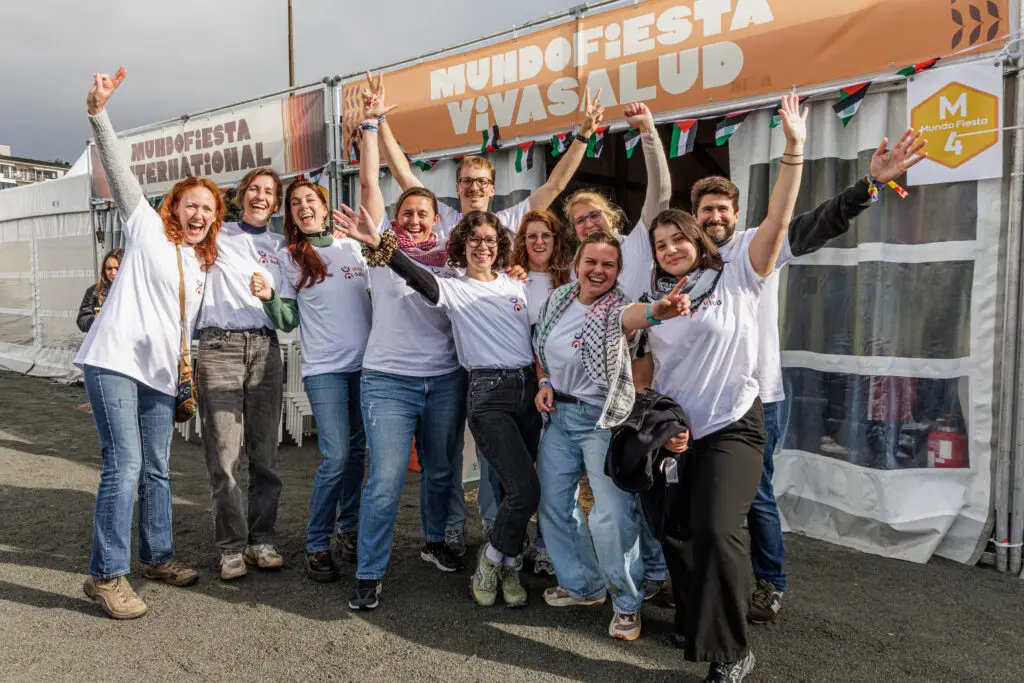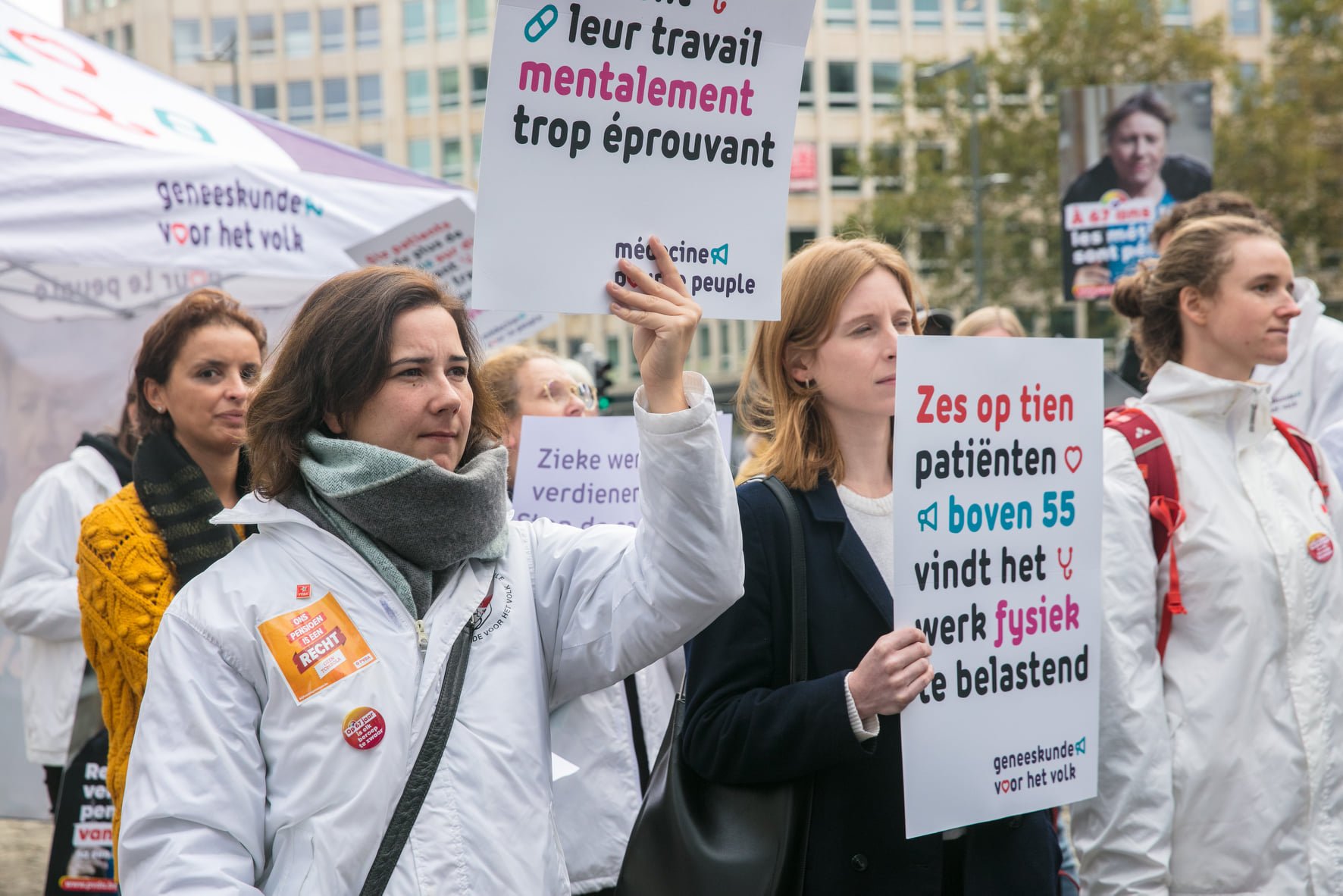
Janneke Ronse is chair of Medicine for the People (MPLP). With 220 employees·e·distributed·e·Operating from 11 medical practices, the charity provides free healthcare to nearly 25,000 patients·e·s. In this interview, Janneke discusses the global struggle of healthcare workers for better working conditions and high-quality public healthcare.
We are seeing protests by healthcare workers all over the world. What is going on?
The situation in the healthcare sector was already very difficult before the pandemic. With the Covid-19 crisis, healthcare staff were hoping that their working conditions would finally improve. And with good reason: ministers took turns praising and thanking them for their courage, and the public applauded them from their balconies every evening. Yet it would seem that, as the months have passed, the crisis in the healthcare sector has faded from view. But on the ground, people are exhausted. There is a great deal of anger.
Last week, I spoke to a British nurse. He is heavily involved in the strikes sweeping the country in the fight for better working conditions and, in particular, to safeguard the NHS, the British public health service. In the UK, there is no automatic pay rise linked to inflation. In other words, healthcare staff have seen their purchasing power fall by 10 % due to inflation. He explained to me that more and more practising nurses are turning to food banks.
Of course, every country has its own context. But working conditions in the healthcare sector have been deteriorating globally for years. Healthcare staff can no longer provide patients with the care they would like to give. All of this is sapping the motivation of healthcare workers. It seems as though they have to treat people mechanically: like cars on an assembly line in a factory. Recently, a home care nurse told me she only had nine minutes to help a patient wash. She confided in me that she quickly felt overwhelmed and caught off guard when a patient needed more time for a bit of company or comfort.

There are an increasing number of checks and controls, administrative work is taking precedence over patient care, and staff are having to work with ever greater flexibility. Working hours are constantly changing and the workload is enormous. Cost-cutting in the health sector is the main problem. Staff are now viewed as a budget item, rather than as providers of care. To break this cycle, we need to take measures that go against the current trend. But governments are content to merely patch things up, or even take measures that exacerbate the problems. That is why trade unions and social movements around the world are taking to the streets today.
Efficiency, time management and administrative tasks seem to be taking precedence over patient care. How does MPLP still manage to put patients first?
Providing healthcare is, by its very nature, a human endeavour. There is no place for the profit motive here. Médecine pour le Peuple operates on a flat-rate system. We are not paid on a performance basis, but have a fixed budget that enables us to cover all our costs. This means we are less preoccupied with every penny and can devote more time to our patients. For example, we hold 20-minute consultations. This is longer than in the average GP practice.
It is very important to us to support our patients. This is what we call «the doctor as a companion». We involve people in their diagnosis, we take more time to explain the social determinants of illness, and we decide on the way forward together. Above all, we start with the patients’ needs and organise our team accordingly. If we see a lot of people with mental health issues in a particular practice, we may decide to recruit an additional psychologist. This model gives us a great deal of flexibility. It also encourages us to take a more preventative approach. In a flat-rate system, it is in our interest to prevent people from falling ill and requiring extensive care.
An alternative healthcare model, in which there is no room for profit, is urgently needed. Are community health centres the solution?
Healthcare is, of course, a much broader field, but community health centres remain a very important part of it. With a strong primary care system, we can prevent many other problems. For example, with good home nursing care, a good GP and a team of more informal carers, we can prevent a large number of people from having to go to hospital.
Our country is very good at treating people, but when it comes to prevention, our results are truly poor. We invest only 2 % of the health budget in prevention. In our view, this figure should be at least 5 %. Compared with other Western European countries, Belgium is lagging behind when it comes to preventable deaths. Yet we do have good prevention campaigns. However, these are not really being implemented on the ground. With adequately staffed prevention centres across the country, we could give these campaigns greater impact and effectively convey information to the public.
Are working conditions better in community health centres? How does the work involved in providing care differ?
Why do people choose a career in the care sector? Because they want to look after people. We sometimes forget the importance of job satisfaction. If we can’t really look after others, we’ll hit a brick wall in the long run. The rate of burnout in the care sector is twice as high as in other professions. Many people are leaving the sector, but I believe we can bring them back by making significant improvements to their working conditions.
At MPLP, we work a lot as a team. Our colleagues work together to determine the best care to provide for patients in their practices. Working as a team enables us to delegate our administrative tasks to other colleagues and to collaborate with other disciplines, such as nurses and doctors.